


How cold does it get in the desert at night? Much colder than many first-time visitors expect. The Moroccan Sahara can move from warm or even scorching afternoons to genuinely cold nights, especially from December through February. Around Merzouga and the Erg Chebbi dunes, winter nights commonly fall into the low single digits Celsius, and exposed conditions can feel colder once you are away from buildings and the afternoon sun.
The reason is not mysterious desert folklore. Dry air and usually clear skies allow heat absorbed during the day to escape rapidly after sunset. NASA explains that desert temperatures can change dramatically from day to night because very dry air does not hold heat efficiently. In Morocco, that daily temperature swing is one of the most important things to understand before booking an overnight desert camp.
This guide covers desert temperature at night in Morocco by season, why the Sahara cools so quickly, what to wear, what to pack for Merzouga, and how conditions differ between winter and summer. If you are already planning a Sahara trip, see our best time to visit Merzouga and Morocco desert itinerary.
Table of Contents
- How Cold Is the Desert at Night? Quick Answer
- Why Does the Desert Get Cold at Night?
- How Cold Is the Sahara Desert at Night in Winter?
- Desert Nights in Spring
- Does the Sahara Get Cold at Night in Summer?
- Desert Nights in Autumn
- Merzouga vs Zagora at Night
- What Should You Wear in the Desert at Night?
- How to Stay Warm in a Sahara Desert Camp
- What About Sunset Camel Rides?
- Is the Desert Too Cold at Night for Children?
- Best Months for Comfortable Desert Nights
- Common Desert Temperature Mistakes to Avoid
- Frequently Asked Questions About Desert Temperatures at Night
- Final Answer
How Cold Does It Get in the Desert at Night? Quick Answer
In the Moroccan Sahara, nighttime temperature depends heavily on season. Recent 2026 climate guidance for Merzouga published by MétéoMaroc gives typical nighttime ranges of around 2–6°C in January and February, 4–8°C in December, about 10–15°C in March and April, and roughly 25–30°C during June to August. These are practical ranges rather than guarantees, and wind, cloud cover, exact location and unusual weather can push conditions outside them.
| Season | Typical Merzouga Night Range | What It Feels Like |
|---|---|---|
| Winter (Dec–Feb) | About 2–8°C | Cold; warm layers essential |
| Spring (Mar–Apr) | About 10–15°C | Cool to mild |
| Late spring (May) | About 18–22°C | Comfortable to warm |
| Summer (Jun–Aug) | About 25–30°C | Warm, often hot |
| September | About 20–25°C | Warm |
| Autumn (Oct–Nov) | About 12–18°C | Cool and comfortable |
Those figures come from a recent Merzouga weather guide, while the broader scientific explanation is supported by NASA’s desert biome overview. The important travel lesson is simple: do not pack for a Sahara overnight based only on the afternoon forecast.

Why Does the Desert Get Cold at Night?
Deserts cool quickly because they combine several conditions that favor rapid heat loss. First, desert air contains relatively little water vapor. Water vapor helps retain heat in the atmosphere, so dry air loses warmth faster once the sun disappears.
Second, desert skies are often clear. Clouds can act like a blanket by absorbing and re-radiating heat back toward the surface. With fewer clouds, more heat escapes upward at night. Third, sand and bare ground can heat quickly during the day but also cool quickly once solar radiation stops.
NASA summarizes the process clearly: desert temperatures can shift sharply between day and night because dry air allows heat to escape rapidly. That is why a traveler can wear a T-shirt during a sunny winter afternoon in Merzouga and need a fleece, jacket and warm socks only a few hours later.
The contrast can be stronger than the actual number suggests. A drop from 22°C in the afternoon to 4°C before dawn is an 18-degree change. Your body notices that transition, especially after sitting outside at a camp for dinner, music or stargazing.
How Cold Is the Sahara Desert at Night in Winter?
Winter is when travelers are most likely to underestimate the cold. January and February are among the chilliest months around Merzouga. Recent local weather guidance places typical nights around 2–6°C, with some nights near freezing. December is usually only slightly milder.
That does not mean the Sahara is covered in frost every night. Daytime weather can still be bright and pleasant, often making winter one of the best seasons for camel trekking and dune walks. The issue is the rapid temperature fall after sunset.
If you are staying in a traditional-style camp, ask what bedding is provided. Many established camps supply heavy blankets, and luxury camps may have better insulation or heating arrangements, but you should not assume every tent is heated. A warm base layer, fleece and insulated outer layer make a huge difference.
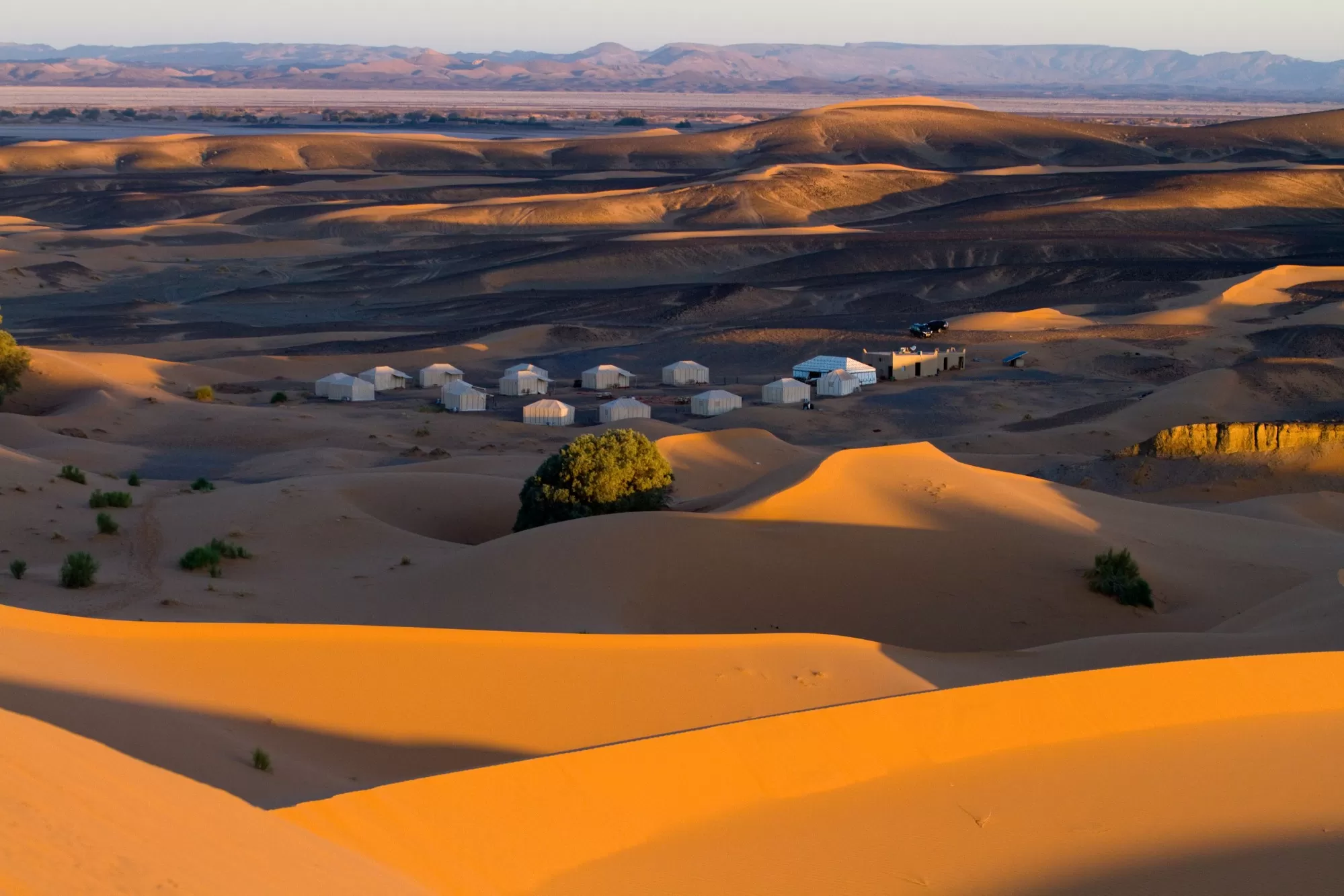
Desert Nights in Spring
March and April are excellent months for many travelers. Daytime temperatures are warmer than winter, while nights around Merzouga are often in the 10–15°C range. You still want a light jacket or fleece, but the cold is less severe than in January.
Spring is popular because it balances comfortable walking weather, pleasant evenings and good conditions for overnight camps. Wind can still make a mild temperature feel cooler, so a thin wind-resistant layer is useful.
By May, nights are usually much warmer. The bigger concern begins to shift toward daytime heat, especially later in the month.
Does the Sahara Get Cold at Night in Summer?
Not necessarily. This is where the common phrase “deserts are freezing at night” becomes misleading. In June, July and August, nighttime temperatures around Merzouga can remain in the mid-to-high twenties Celsius. After an extremely hot day, 27°C may feel cooler, but it is not cold.
Summer daytime heat is the real issue. MétéoMaroc lists daytime ranges of roughly 42–47°C for June through August around Merzouga. That level of heat can make midday dune activities unsafe or impractical. Many desert operators adjust activity times toward sunrise and sunset.
So the correct answer is: desert nights can be cold, but not in every season. Winter is the season where warm night clothing matters most.
Desert Nights in Autumn
October and November are among the easiest months for desert travel. Recent Merzouga guidance gives nighttime temperatures around 12–18°C. That is cool enough for comfortable sleeping and stargazing but usually not severe.
September can still be very warm because the desert retains summer conditions. Travelers who dislike heat should favor later October or November over early September.
Merzouga vs Zagora at Night
“Moroccan desert” covers different landscapes and climates. Merzouga sits beside Erg Chebbi and is the classic large-dune destination. Zagora is farther west and sits at a different elevation and geographic position. Both can have cold winter nights, but local temperatures are not identical.
The practical packing rule is the same: check the forecast for the exact destination rather than using “Sahara” as if it were a single weather station. If your itinerary includes both mountain passes and desert camps, you need even more flexible clothing.
What Should You Wear in the Desert at Night?
Layering is the best strategy because the temperature changes so much between afternoon, sunset and early morning.
Winter Packing List
- Long trousers
- Long-sleeve base layer
- Warm fleece or sweater
- Insulated or wind-resistant jacket
- Warm socks
- Closed shoes
- Light scarf or buff
- Optional beanie for January and February
Spring and Autumn
- Long trousers
- T-shirt plus light long-sleeve layer
- Fleece or lightweight jacket
- Closed shoes or sturdy sandals depending on activity
Summer
- Loose breathable clothing
- Sun hat and strong sun protection
- Light layer for late night if you are sensitive to temperature changes
- Plenty of water
Do not bring only one heavy coat and nothing else. Layers let you adapt hour by hour, which is much more useful in a desert climate.
How to Stay Warm in a Sahara Desert Camp
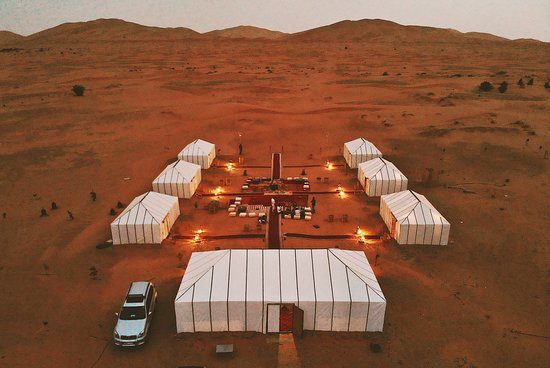
A good camp should provide bedding, but comfort varies. Before booking, ask whether tents have proper blankets, private bathrooms, heating and enclosed dining areas. “Luxury camp” is a marketing term, not a standardized technical category.
Keep your warm layers accessible rather than buried at the bottom of a suitcase that has been left in another vehicle. Put on your fleece before you feel cold. Wear dry socks to bed. If the camp offers extra blankets, request them early rather than at 2 a.m. when everyone has disappeared into their tents.
If you are very sensitive to cold, consider a camp with more solid tent construction or a nearby hotel stay. Our best desert camps in Merzouga guide helps compare different styles of accommodation.
What About Sunset Camel Rides?
Sunset rides often begin while the day is still warm and end after the temperature has started dropping. In winter, carry your jacket with you rather than leaving it at camp. A scarf also helps with both wind and sand.
Camel trekking in Merzouga is one of the classic experiences on a Marrakech to Merzouga desert tour, but the quality of the experience depends heavily on season and time of day.

Is the Desert Too Cold at Night for Children?
Not usually, provided families choose the right season and accommodation. March, April, October and November are generally easier than midwinter for young children because nighttime temperatures are milder.
For a December or January trip, confirm bedding and heating with the camp in advance. Bring warm pajamas and multiple layers. Parents should also remember that young children can become cold more quickly when sitting still outdoors after dinner.
Best Months for Comfortable Desert Nights
For the best balance of daytime warmth and manageable nights, March–April and October–November are excellent choices. Winter offers clear skies and dramatic temperature contrast, but requires proper cold-weather packing. Summer is much less attractive because of extreme daytime heat, even though nights are warm.
For a month-by-month look at the region, read our Merzouga weather guide and broader best time to visit Morocco article.
Common Desert Temperature Mistakes to Avoid
The most common mistake is checking only the daytime high. A forecast showing 22°C can look perfect until you notice that the overnight low is close to 4°C. The second mistake is assuming every tent has hotel-style insulation. Desert camps vary enormously, and canvas or fabric structures lose heat quickly. The third is packing fashion-first clothing that works for photographs but not for sitting outside after sunset.
Check both the daily maximum and minimum, ask your camp what bedding is supplied, and keep one warm layer in your day bag. Those three small steps prevent most cold-night surprises.
Frequently Asked Questions About Desert Temperatures at Night
How cold does it get in the desert at night in Morocco?
Around Merzouga, winter nights commonly fall into roughly the 2–8°C range, while spring and autumn are milder. Summer nights can remain above 25°C.
Can the Sahara reach freezing temperatures at night?
Yes, some exposed desert areas can approach freezing during cold winter nights. Around Merzouga, near-freezing temperatures are possible in winter even though sunny daytime weather can feel comfortable.
Why is the desert cold at night?
Desert air is very dry and skies are often clear, so heat escapes rapidly after sunset. NASA identifies this rapid nighttime heat loss as a key feature of desert climates.
Do I need a jacket in the Sahara?
In winter, absolutely. In spring and autumn, a light or medium jacket is wise. In midsummer, a jacket may be unnecessary at night, though a light layer can still be useful.
What is the coldest time of night in the desert?
Temperatures usually continue falling through the night and are often lowest shortly before or around sunrise.
Are desert camps heated?
Some luxury camps have heating or better insulation, while simpler camps may rely on blankets. Always confirm with the specific property before booking.
Is January a good time for Merzouga?
Yes if you are prepared for cold nights. Days can be pleasant, crowds may be lighter, and clear winter skies are excellent for stargazing.
What is the best season for a Sahara overnight?
For many travelers, March–April and October–November offer the easiest balance of comfortable daytime and nighttime temperatures.
Final Answer
So, how cold does it get in the desert at night? In Morocco, the answer ranges from near-freezing winter conditions to warm summer nights. The dramatic change is caused by dry air, clear skies and rapid heat loss after sunset.
Pack for the season, not the postcard. A winter Sahara trip can be spectacular if you bring warm layers, while spring and autumn offer the most forgiving conditions. When you are ready to build the route, explore our Morocco tours, Merzouga guides and desert itineraries.
