


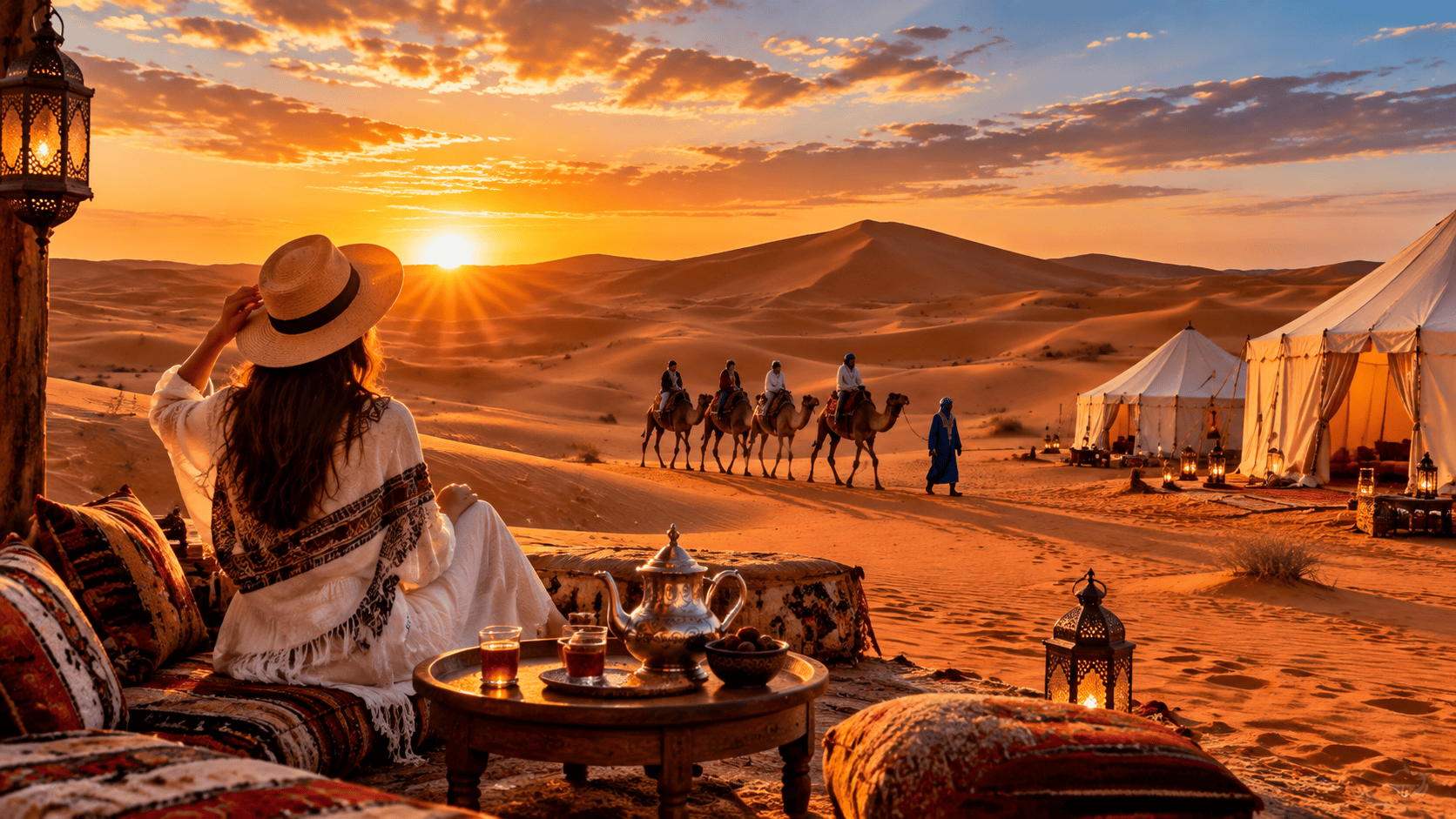
Sahara Desert facts become much more interesting once you move beyond the familiar image of a camel crossing orange dunes. The Sahara is a vast, complex region of sand seas, rocky plateaus, mountains, dry valleys, oasis systems and human communities spread across North Africa.
Morocco gives travelers relatively accessible routes into the northwestern Sahara, especially around Merzouga and M’Hamid. These areas are famous for dunes, camps and camel rides, but they are only a small part of the desert story. Here are 15 useful and surprising facts about the Sahara, followed by practical notes for anyone planning to visit.
Table of Contents
- 15 Sahara Desert facts
- The Sahara in Morocco
- Climate and temperatures
- People and culture
- How to visit
- Responsible desert travel
- FAQ
15 Fascinating Sahara Desert Facts
1. The Sahara is not one country
The Sahara stretches across a large belt of North Africa. Morocco occupies only its northwestern edge, while the desert also extends through Algeria, Tunisia, Libya, Egypt, Mauritania, Mali, Niger, Chad and Sudan.
2. Most of the Sahara is not covered in dunes
The postcard image of endless sand is only part of the story. Rocky plateaus, gravel plains, mountains, dry valleys and salt flats make up huge areas. Sand seas are called ergs.
3. Morocco has two famous dune regions
Erg Chebbi rises beside Merzouga, while Erg Chigaga lies farther south near M’Hamid. Both offer camel rides and camps, but access, scale and travel style differ.
4. Desert nights can be cold
Low humidity and clear skies allow heat to radiate away quickly after sunset. Winter nights can feel surprisingly cold, which is why a warm layer belongs in a Sahara packing list.
5. Dunes move
Wind constantly reshapes dune ridges. The exact surface pattern you photograph at sunset may look different after strong wind, even though the wider erg remains in place.
6. Water shapes desert settlement
Oases, wells and seasonal water sources have historically influenced routes and communities. Palm groves often mark places where groundwater or river systems support agriculture.
7. The Sahara has mountains
The desert is not flat. Across North Africa it includes major mountain systems, volcanic massifs and rocky highlands. Morocco’s desert routes also cross or run beside the Atlas ranges.
8. People have crossed the Sahara for centuries
Caravan routes connected North and sub-Saharan Africa, moving salt, gold, textiles and other goods. Modern roads changed transport, but historic trade shaped many oasis towns.
9. Camels are adapted to arid travel
Dromedary camels tolerate heat and water scarcity far better than horses. Their role in transport helped make long-distance desert trade possible.
10. Sand is a poor heat store at the surface
Loose dry sand heats rapidly in direct sun and also loses heat quickly after sunset, contributing to the large difference between daytime surface heat and nighttime conditions.
11. The Sahara was not always as dry as today
Climate has shifted repeatedly. During past humid periods, areas that are now desert supported lakes, grasslands and larger human and animal populations.
12. Desert plants are highly specialized
Plants may use deep roots, small leaves, waxy surfaces or short life cycles after rare rain. What looks empty often contains species precisely adapted to scarcity.
13. Flash floods can happen in deserts
Dry riverbeds can fill rapidly after intense rain, sometimes far from where the rainfall occurred. Desert does not mean flood-proof.
14. Stars appear exceptionally bright
Remote desert areas have little artificial light, so clear nights can reveal dense star fields. Moon phase matters if stargazing is a priority.
15. The Moroccan Sahara is culturally diverse
Amazigh, Arab, Sahrawi and other communities have shaped languages, music, food, architecture and trade across Morocco’s southern regions.
Is the Sahara Desert in Morocco?
Yes. Morocco reaches into the northwestern Sahara, and tourism concentrates on accessible dune systems and oasis routes. Marrakech to Sahara itineraries typically head toward Merzouga and Erg Chebbi, while southern routes can continue through the Draa Valley toward M’Hamid and Erg Chigaga.
Calling Merzouga “the Sahara” is convenient for travel planning, but the Sahara itself extends across a much larger part of North Africa. A three-day Morocco tour samples one small edge of a continental-scale environment.
How Hot and Cold Is the Sahara?
Summer daytime heat can be extreme, while winter days may feel pleasantly warm. Nighttime temperatures can fall sharply. The exact conditions depend on season, wind, elevation and location, so broad claims such as “the desert is always hot” are useless for packing.
Our detailed guide to desert temperatures at night explains why dry air and clear skies create large daily temperature swings.
People, Culture and the Sahara
The Sahara is not empty. Communities have long adapted to scarce water, distance and seasonal movement. Oasis agriculture, pastoralism, trade and modern towns coexist. In Morocco, desert tourism also supports drivers, camp staff, guides, craftspeople, musicians and accommodation businesses.
Visitors should resist describing the region as “untouched” when people have lived, traveled and traded through it for centuries. The landscape is dramatic precisely because natural and human history overlap.
How to Experience the Sahara in Morocco
For large accessible dunes, Merzouga is the most common choice. It connects to paved roads and has a wide range of hotels and camps. Erg Chigaga feels more remote and normally requires a 4×4 approach from the M’Hamid region.
From Marrakech, the classic route takes at least three days for Merzouga. From Fes, Merzouga can be reached in one long driving day, but a multi-day tour creates a better experience. Explore our Morocco desert tours and Marrakech desert tours pages for route options.
Responsible Sahara Travel
Choose camps that manage waste and water responsibly. Avoid leaving plastic, wipes or cigarette ends in the dunes. Follow established vehicle tracks when possible and do not pressure wildlife for photographs.
For camel activities, look for animals in good condition with appropriate saddles and handlers who allow rest and water. Our camel rides in Morocco guide explains what to look for.
What to Pack for the Sahara
Bring sun protection, sunglasses, a scarf, comfortable closed shoes, water and layers. A warm fleece or jacket is important in winter. Sand can reach cameras and electronics easily, so use a simple protective bag rather than discovering that your lens now makes a grinding noise with every zoom.
Download key information offline because signal can be inconsistent around remote camps. Keep medication and essential items in a small overnight bag if your larger luggage remains with the vehicle.
More Sahara Facts for Travelers
The Sahara Is a Climate Region, Not a Single Uniform Landscape
People often imagine the Sahara as one continuous field of dunes, but desert geography is more varied. Rocky plateaus, dry valleys, low mountain chains, gravel surfaces and dune fields can sit within the same broad climatic zone. This matters for travelers because the road to Merzouga or M’Hamid may look stony and almost lunar for hours before large dunes appear. The absence of sand does not mean you have somehow left the desert.
Rain Is Rare but Not Impossible
Desert rainfall is irregular rather than nonexistent. When rain does fall, compacted ground may absorb water slowly and dry channels can fill quickly. That is why drivers take local warnings seriously after storms. A dry wadi that looked harmless in the morning can become dangerous when runoff arrives from higher ground.
Wind Changes the Experience Dramatically
Wind affects temperature, visibility and comfort more than many first-time visitors expect. Strong wind can lift fine sand, flatten footprints within minutes and make a sunset camel ride less romantic than the brochure suggested. A scarf, sunglasses and closed bag for electronics are simple but useful protection.
Desert Silence Is Relative
Remote camps can feel extraordinarily quiet, especially after generators are switched off. Yet the desert still has sound: wind along dune ridges, insects, animals, camp activity and distant vehicles. The sense of silence comes partly from the absence of dense urban noise rather than literal acoustic emptiness.
Sunrise and Sunset Are Popular for a Reason
Low-angle light creates shadows that reveal dune shape, while midday sun can flatten texture. Temperatures are also more comfortable around sunrise and sunset. If photography matters, arrive at a viewpoint early enough to choose a position without climbing unstable ridges in the dark.
Not Every Camp Is Deep in the Dunes
Some camps sit at the edge of an erg with vehicle access nearby; others require a longer 4×4 or camel transfer. Neither is automatically better. Edge camps can be convenient for families and travelers with mobility limits, while more remote camps offer greater isolation. Check the exact location rather than judging from the words “luxury Sahara camp.”
Frequently Asked Questions
Is the Sahara Desert in Morocco?
Yes. Morocco includes a northwestern portion of the Sahara region, and travelers most commonly visit dune areas such as Erg Chebbi near Merzouga and Erg Chigaga near M’Hamid.
How big is the Sahara Desert?
The Sahara covers a vast part of North Africa across multiple countries. It is far larger than Morocco, so the Moroccan Sahara is only one part of the wider desert.
Does it get cold in the Sahara at night?
Yes. Dry air and clear skies allow heat to escape quickly after sunset, especially in winter. Nights can feel very cold even after a warm day.
Are there sand dunes everywhere in the Sahara?
No. Much of the Sahara consists of rocky plateaus, gravel plains, mountains and dry valleys. Large dune seas, called ergs, are only one type of desert landscape.
Do people live in the Sahara?
Yes. Towns, oasis communities, nomadic and semi-nomadic groups live across Sahara regions, adapting to water, trade, livestock and modern infrastructure.
What animals live in the Sahara?
Desert-adapted reptiles, insects, birds, foxes and other mammals survive in the Sahara. Wildlife is generally sparse and adapted to heat and limited water.
What are the main Sahara dunes in Morocco?
Erg Chebbi near Merzouga and Erg Chigaga near M’Hamid are the best-known large dune areas visited by travelers.
When is the best time to visit the Moroccan Sahara?
Spring and autumn are popular, while winter has comfortable days and cold nights. Summer can be extremely hot.
More Practical Planning Advice
Sahara Geography in Simple Terms
An erg is a large area of dunes; a hamada is a rocky plateau; a reg is a gravelly desert surface. Learning these terms helps explain why the Sahara can look completely different from one region to another.
Photography in the Desert
Protect equipment from blowing sand, avoid changing lenses in wind and carry spare batteries because cold nights can reduce battery performance. Sunrise and sunset create lower contrast than midday and reveal dune texture more clearly.
Why Visitors Misunderstand the Sahara
Tourism advertising naturally chooses the most photogenic dunes, so many people arrive believing the entire Sahara is sand. The reality is geologically richer and makes road journeys more interesting once you know what you are looking at.
Build Realistic Travel Time Into the Day
Road distances in Morocco can look modest on a map but take longer because of mountain bends, village traffic, construction and worthwhile stops. Do not build an itinerary around perfect driving conditions. Add margin for meals, photography and unexpected delays.
Use Local Knowledge
Hotel staff, licensed guides and experienced drivers can provide current information about road conditions, seasonal closures and local events. Verify important logistics close to travel rather than assuming an older blog post is still exact.
Travel With Respect
Ask before photographing people, support local businesses and avoid treating residential areas as open-air sets. Morocco is easy to enjoy when curiosity is paired with basic courtesy.
