


Table of Contents
Quick answer: The best leather goods to consider buying in Fes are well-made handbags, crossbody bags, babouche slippers, wallets, belts, journal covers and unstuffed leather poufs. The right choice depends less on a shop’s claims about tradition and more on material, stitching, finishing, comfort and what you can realistically carry home. Fes is especially interesting because the historic medina brings tanneries, craft workshops and leather retailers into the same urban landscape.
Fes is a destination for travelers who want to understand how Moroccan crafts are made, not merely collect souvenirs. Its leatherwork is one reason to explore the old city with curiosity. The Moroccan National Tourist Office identifies tanning and leather goods among Fes’s signature crafts, while UNESCO recognizes the Medina of Fez for its exceptional heritage and living traditions. That context makes a leather purchase more interesting, but it does not mean that every item in every shop is handmade or locally tanned.
Why is Fes famous for leather?
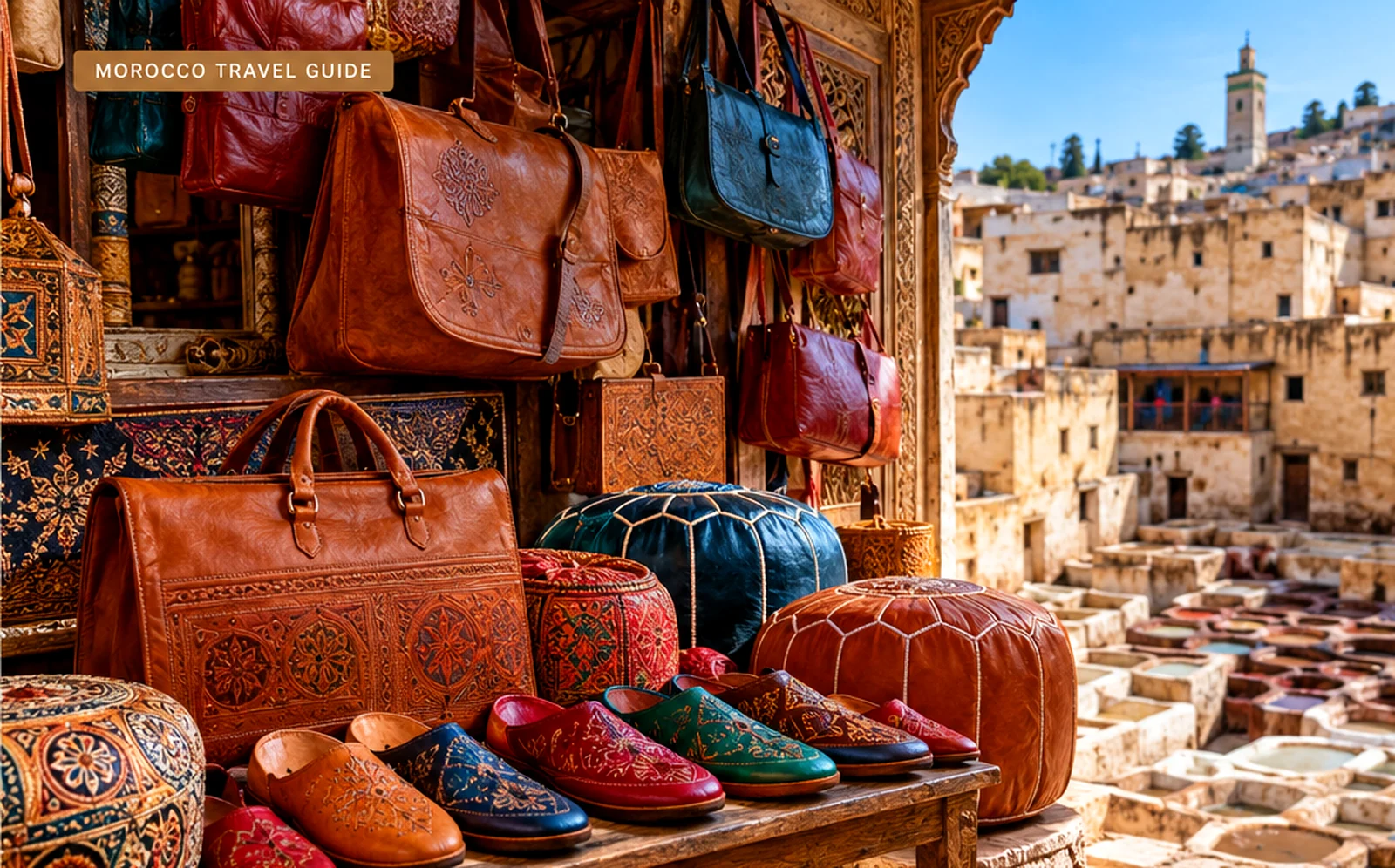
Much of the city’s craft identity is concentrated in Fes el-Bali, where workshops, residential lanes, religious buildings and markets are woven together. At the Chouara Tannery, hides are processed and colored in a working environment that has become one of the city’s most recognizable sights. The tannery is a place of labor, not a themed display built solely for visitors. From permitted surrounding terraces, travelers can appreciate both the distinctive vats and the larger sequence of work behind the finished products seen in the souks.
Leather production is not the same as leather-product manufacturing. A hide may be prepared in one place, cut elsewhere, stitched by another artisan and finally sold by a retailer. Asking about these different stages helps you understand what you are purchasing. A bag displayed near a historic tannery is not automatically proof that the bag was entirely made there. Likewise, a well-made product from a more modern workshop can still be a worthwhile purchase.
Seven leather products worth looking for in Fes

1. Handmade-looking leather handbags and crossbody bags
Bags are a practical choice because they can be used regularly after a trip. You may see soft shoulder bags, structured satchels, small crossbody styles and decorative purses. Start with purpose: a travel bag needs comfortable straps and reliable closures, while a small evening bag may prioritize appearance. Ask to open every compartment and check whether the bag keeps its shape when empty.
Look closely at the points where straps meet the body. A beautiful front panel cannot compensate for weak handles, crooked seams or a zipper that catches. Stitching should be consistent, with reinforcement at places that carry weight. Examine both the exterior and lining. Dark dye rubbing onto pale clothing is a genuine inconvenience, so ask about color transfer and consider a discreet test only with the seller’s permission.
2. Babouche slippers
Babouches are traditional Moroccan slippers and among the most recognizable things to bring home. Designs vary, including pointed-toe styles, embroidered versions and plainer everyday pairs. Try them on rather than relying on your usual shoe size. The heel, toe shape and sole flexibility can change the fit considerably.
Check the inside for rough seams, check that the sole is securely attached and decide whether you intend to wear them indoors or outdoors. Some attractive traditional slippers are better suited to indoor use than rainy streets. If you are choosing a gift, foot measurements are more useful than guesses based on the recipient’s normal European, UK or US size.
3. Leather wallets and cardholders
A wallet offers a lower-commitment way to appreciate leather craftsmanship. Small pieces are easy to carry, and you can inspect most of the construction quickly. Check card slots for usable width, note whether folded edges are securely finished and inspect the stitching around frequently handled corners. A wallet that looks attractive but will not hold your cards comfortably is not a bargain at any price.
4. Leather belts
Belts are useful gifts, but only when size and construction are right. Measure your waist or a belt you already wear before shopping. Examine the buckle attachment, punched holes and edges. If the belt is described as solid leather, ask whether it consists of one leather layer, bonded material or several laminated layers. Those constructions perform differently over time.
Try bending the belt gently without creasing it aggressively. Look for cracks in surface coatings and loose layers at the edges. If a shop offers to shorten a belt, have the fit confirmed before alterations. An elegant buckle can be replaced; a poorly constructed strap is harder to rescue.
5. Leather poufs and floor cushions
Moroccan leather poufs are popular decorative pieces, especially when visitors want something connected to the country’s interior-design traditions. Many are sold without stuffing, which makes them easier to pack. Before purchasing, ask whether the listed price includes filling and whether the seams and zipper are suitable for repeated use.
Look at how the panels meet, particularly around the top and base. Uneven decorative stitching may be part of a handmade appearance, but loose threads and openings are not desirable. Ask for care advice and consider how the color will work at home. A pale pouf might suit a living room visually but require more care than a darker one in a busy household.
6. Notebook and journal covers
Leather-bound notebooks make compact souvenirs and gifts. They are especially appealing when the cover has simple embossing or a restrained pattern. Check whether the paper is replaceable and whether standard refill sizes fit. A reusable cover will have more practical life than a one-off notebook that becomes difficult to use after the final page.
Check fasteners, binding and the finish of the inside cover. Ask whether any decoration is embossed into the leather or printed onto a surface coating. Both can be legitimate choices, but they may age differently. Travelers who prefer lightweight luggage often find small stationery more convenient than jackets or bulky homeware.
7. Leather jackets and larger accessories
Jackets, briefcases and larger accessories can be excellent purchases when fit and quality are carefully checked. They are also among the items where mistakes are costly. Try a jacket with the layers you actually plan to wear beneath it. Move your arms, close the zipper and inspect the seams around the shoulders and underarms.
Ask about the lining, hardware, return or alteration options, and the origin of the leather. Do not assume that a jacket’s price proves it was made locally or traditionally tanned. If you are unsure, leave the shop and compare other examples. Taking time is part of sensible shopping, especially with expensive items.
How to recognize a better-quality leather product

There is no single foolproof test for leather quality. Smell, softness and the words used by a salesperson can be useful clues, but none replaces examining construction and asking good questions. Different products require different balances of softness, thickness and strength. A supple handbag and a firm belt may both be high quality without feeling alike.
| Check | What to look for | Why it matters |
|---|---|---|
| Stitching | Secure, reasonably even seams and reinforced stress points | Weak seams shorten useful life |
| Edges | Neat folds, burnishing or well-applied edge finish | Loose layers may fray or separate |
| Hardware | Smooth zippers, secure buckles and functional closures | Hardware is used every day |
| Lining | Clean attachment without holes or loose fabric | Affects comfort and usability |
| Color | Finish appropriate to the product, with no obvious transfer | Protects clothing and furnishings |
| Fit | Comfortable straps, wearable footwear and sensible sizing | A handsome unusable item is still unusable |
You may hear terms such as full-grain, top-grain, suede, split leather or vegetable-tanned leather. These refer to different aspects of material or processing and should not be treated as interchangeable quality grades. Vegetable tanning describes a tanning method, not a blanket guarantee that every colorant is natural, that every hide came from Fes or that every finished bag will last longer. Ask the seller which material is used in the actual item.
Keep inspection respectful. Do not scratch, soak, burn or sharply fold a product to conduct a dramatic ‘authenticity test.’ Those tricks can damage legitimate leather and rarely establish origin. A careful look at workmanship, paired with a clear description on the receipt, is more useful.
Where to shop for leather in Fes

The Chouara Tannery area
The area around Chouara is a natural starting point for a visitor interested in the relationship between tanning and finished goods. Shops near the tannery may have viewpoints and collections of leather products. Ask permission before going onto a private terrace and confirm whether viewing is offered with conditions. Purchasing is your decision; access arrangements and selling practices can vary.
Remember that a scenic location has value in its own right and may influence the retail price. It is sensible to enjoy the visit, note styles you like and compare products elsewhere before committing. Treat any claim of a guaranteed ‘factory price’ as something to verify, not a fact established by proximity to the vats.
Craft lanes in Fes el-Bali
If you are traveling with a professional guide, explain at the beginning whether you want shopping stops or a cultural tour without pressure to buy. That simple conversation helps distinguish meaningful workshop interpretation from an itinerary dominated by retail showrooms. Our Fez Morocco tours guide gives broader context for exploring the old city.
Comparing sellers and workshops
Before buying, compare at least a few examples of the same general type, especially for bags, jackets or poufs. Ask whether the maker is identifiable, whether materials are described clearly and whether the shop can issue a receipt. Some sellers specialize in finished goods rather than production. That is perfectly legitimate; what matters is honest description and the quality of the purchase.
How much do leather goods cost in Fes?
There is no verified universal price list for Fes leather goods. Prices vary with hide type, construction, dimensions, finishing, workshop overhead, location and the skill involved. A compact wallet and a large hand-finished bag should not be evaluated with the same expectations. Nor should a decorative souvenir be automatically compared with a piece designed for heavy daily use.
The most reliable approach is to set a budget for the product category, compare similar examples, and ask the seller what explains meaningful price differences. An item made with thicker material and well-finished seams may justify a higher price. If a claim sounds important, such as a specific tanning method or local provenance, request a written description.
Many traditional souk shops expect some negotiation, while other businesses use fixed prices. Bargain politely where it is welcomed, and do not feel compelled to accept a deal that exceeds your budget. There is no need to treat every transaction as a contest. For more context, consult our Moroccan markets and bargaining guide.
A responsible visit to a working tannery
Historic tanning is visually memorable, but the people working there deserve privacy and respect. Observe only from places where visitors are permitted and do not enter restricted working areas. Ask before photographing workers closely. The smell can be strong, so travelers sensitive to odors may prefer a shorter visit.
Do not assume that all color baths are made exclusively from natural pigments or that every method used today is identical to one from centuries ago. Craft traditions evolve, and workshops may combine techniques. The lasting significance of Fes lies in the continuity of skills and the working life of the medina, not in exaggerated claims designed to make every purchase sound like an antique.
UNESCO’s description of the Medina of Fez explains why the historic city is recognized internationally. The Moroccan National Tourist Office’s craft overview also provides useful background on leather and other Moroccan traditions.
How to avoid disappointing purchases

One common mistake is shopping solely by smell. A strong scent does not prove high quality, and a mild scent does not prove a product is synthetic. Finishes, storage and tanning choices affect odor. Another mistake is ignoring function. If you cannot open the bag comfortably, if the straps dig into your shoulders or if shoes rub your feet in the shop, the problem is unlikely to disappear simply because the object came from Fes.
How to care for Fes leather after your trip
Store leather products in a cool, dry, ventilated place away from prolonged direct sunlight and heat. Wipe off ordinary dust with a soft cloth. Follow any maker-specific care instructions, because suede, finished leather and uncoated leather may need different treatment. Test cleaning products on a hidden area first and avoid saturating leather with water.
Plan a Fes craft-focused travel day
Leave time for the tannery district, craft lanes, an unhurried meal and a second round of comparison shopping. You do not need to buy something at every stop. Visitors interested in the broader city can combine artisan exploration with historic architecture, museums and neighborhood walks. If the visit is part of a longer itinerary, browse our Morocco tours from Fes page for travel ideas.
Official travel references: US Customs and Border Protection and Canada Border Services Agency.
For any shipped order, request the shipping company’s identity, a tracking method, packaging details, the declared value and a written understanding of what happens if an item arrives damaged. Photograph the completed purchase and its invoice before it leaves the shop. These practical checks are especially useful for cross-border purchases, where returning goods can cost more than expected.
Some products require particular care. Empty pouf covers are easier to pack than stuffed poufs; avoid uncertain stuffing materials if you plan to cross a border. Buyers considering exotic or protected animal materials should ask about species and applicable wildlife documentation instead of assuming every item sold in a market can be legally imported. A common leather bag, wallet or slipper made from clearly described conventional materials is a more straightforward souvenir choice than an item with unclear provenance.
For larger purchases, request a detailed invoice showing the shop’s name, the item, material description and actual amount paid. Keep that documentation available for customs on arrival. Import allowances and declarations differ by destination and can change: US-bound travelers should consult US Customs and Border Protection, while Canadian travelers should consult the Canada Border Services Agency. We deliberately do not quote a universal duty-free amount because eligibility may depend on your travel history and other circumstances. The point is to make an informed purchase, not to discover a documentation problem at the airport.
If you are visiting Morocco from the United States or Canada, consider where the piece will live after your trip before agreeing to buy it. A leather tote that looks manageable in a shop may become surprisingly bulky when packed with other souvenirs. Measure the approximate width of your intended bag, bring a soft tape measure if you want a pouf cover, and check your airline’s current luggage rules yourself. Airlines and ticket classes handle checked baggage, cabin baggage and oversized items differently, so a store owner’s assurance is not a substitute for the carrier’s written policy.
Buying leather in Fes when you live in the United States or Canada
Frequently asked questions about Fes leather goods
What leather product is Fes most famous for?
Fes is strongly associated with leather tanning and a range of finished goods, including bags, slippers, wallets and other accessories. There is no single objectively ‘best’ product for every traveler; practical use and workmanship should guide the choice.
Is all leather sold in Fes made at Chouara Tannery?
No. Retailers may source hides and finished goods through different workshops and suppliers. Ask about the origin of the specific product if provenance matters to you.
Are leather goods cheaper in Fes than in Marrakech?
There is no reliable citywide rule. Comparable products can vary considerably by materials, seller and location. Compare examples rather than assuming one city always offers lower prices.
Can I visit Chouara Tannery without buying anything?
Visitors commonly view the tannery from nearby terraces, but individual access arrangements may vary. Clarify expectations politely before entering and respect the shop’s rules. Purchasing should not be assumed mandatory without a clearly stated condition.
What is a good lightweight souvenir from Fes?
A wallet, cardholder, journal cover or pair of lightweight slippers is easier to pack than a jacket or large pouf. The best gift is one whose size and intended use you understand.
How can I tell whether a leather bag is worth buying?
Inspect the seams, handles, lining, closures, comfort and overall finish. Ask about material and care. Comparing similar bags from different sellers is more dependable than using smell as a single test.
Continue exploring the medina’s traditional crafts in our guide to Moroccan rugs in Fes. These crafts are often sold near one another, but their materials, origins and quality checks differ.
Final advice
The best leather goods in Fes are the ones whose materials, workmanship and purpose make sense for you. Enjoy the city’s historic crafts, ask informed questions and give yourself permission to walk away from a purchase that is not right. A leather souvenir should become a useful reminder of Morocco, not a regret that takes up space in the suitcase.
