


Table of Contents
Quick answer: Fes is an excellent city to explore Moroccan rugs because its medina brings textile sellers, craftspeople and visitors together. Before purchasing a carpet, identify the style, fiber, approximate origin, dimensions and construction. Ask to see the back, compare several pieces and confirm shipping arrangements before paying. Crucially, a Moroccan rug sold in Fes is not necessarily woven in Fes: many recognized styles originate in communities across the Atlas Mountains and elsewhere in Morocco.
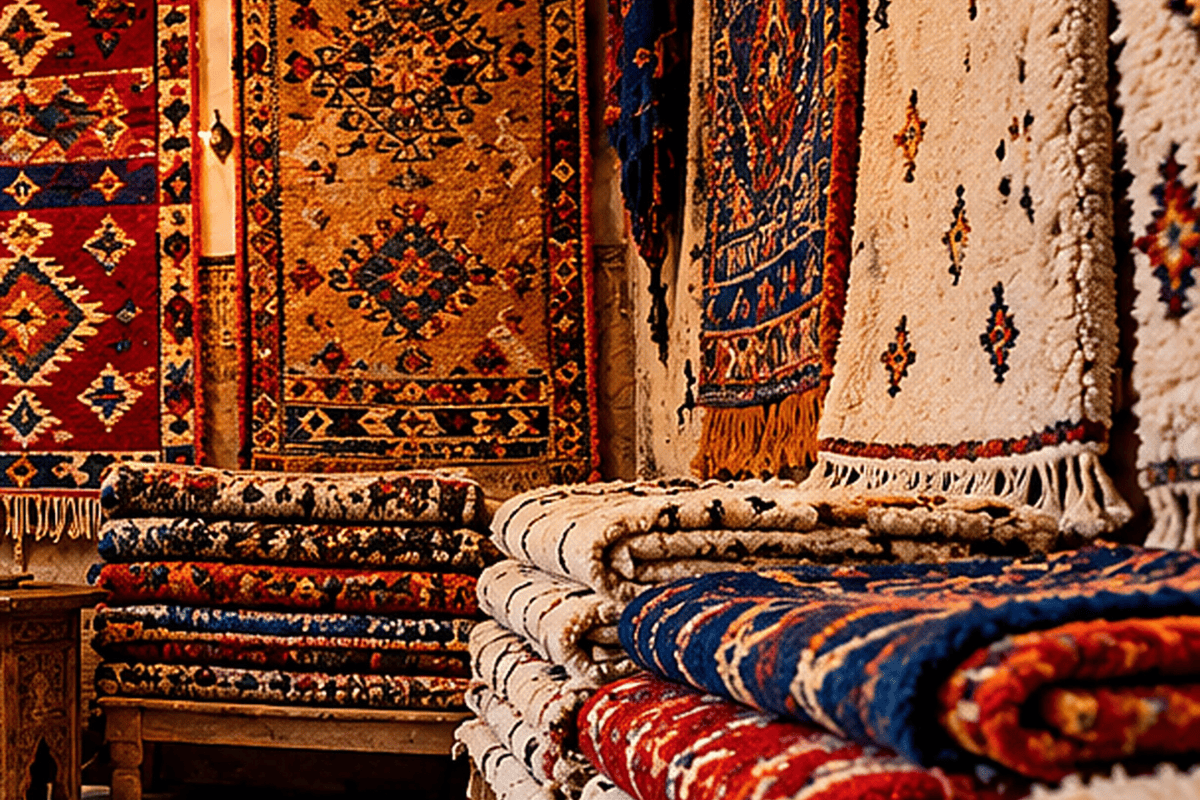
Moroccan carpets range from thick wool pieces with restrained geometric lines to colorful textiles made through different weaving traditions. Some are designed for warmth, others for decoration or flexible household use. A visitor who understands those differences can appreciate the cultural story without accepting every attractive sales description as proof of age or origin.
This guide focuses on choosing and understanding Moroccan rugs in Fes. For a wider look at market culture, bargaining and shopping in other cities, see our complete guide to Moroccan souks.
Why explore Moroccan rugs in Fes?
Fes is one of Morocco’s major heritage destinations. Its historic medina preserves the relationship between daily life, commerce and craft. The Moroccan National Tourist Office includes carpets and weaving among traditional Moroccan crafts, and UNESCO recognizes the Medina of Fez for its living cultural character. These two facts help explain why rug shopping here can be part of a broader visit to artisan districts and historic streets.
Buying from a city retailer and buying directly from a rural maker are different experiences. A Fes showroom may carry a selection from several regions, while a weaving workshop may specialize in one tradition. Neither route is automatically better. A retailer can provide choice, advice and international shipping, while direct sourcing may help buyers understand the maker and production process more clearly. Ask who made a piece and whether that information can be verified.
Moroccan rug styles you may encounter in Fes

Beni Ourain: soft wool and understated patterns
Beni Ourain rugs are associated with communities in Morocco’s Middle Atlas and are recognized internationally for pale wool grounds and often dark geometric designs. Individual examples vary, so one photograph cannot define the entire tradition. If you are considering a thick wool rug, examine density, shedding, softness and whether the pile suits your home. Pale wool is attractive but may be less forgiving in a heavily trafficked room.
Ask about the actual origin rather than assuming that a Beni Ourain label guarantees a particular village. Contemporary pieces can reinterpret established designs. That does not make them worthless, but a modern rug inspired by a regional style is not necessarily the same as a piece produced within that community.
Azilal: expressive color and mixed visual language
Azilal rugs are associated with the central High Atlas and are often described through lively color, varied motifs and individual compositions. They can work particularly well when a room needs one strong textile focal point. Look at the distribution of color across the whole rug, rather than judging by a small folded section. Patterns that look balanced on a shop wall may feel quite different across a living-room floor.
Fiber and construction vary, so ask what is wool and what may be another material. If a seller makes strong claims about the meaning of every symbol, listen with interest but remember that interpretations differ across makers, regions and individual objects.
Boujad: warmer palettes and flexible patterning
Boujad carpets are often associated with the central Moroccan region around Boujad and can feature warm tones and expressive designs. Some are vintage; others are newly produced. Age should never be inferred from fading or an intentionally distressed look alone. A true vintage claim deserves credible information about the piece, its condition and the basis for the seller’s estimate.
Inspect older-looking textiles for weak areas, repairs, uneven wear and smells suggesting poor storage. A rug with character may still require professional cleaning or conservation, expenses that should be considered before purchase.
Boucherouite: creative use of recycled textiles
Boucherouite rugs often incorporate strips or pieces of recycled fabric, creating energetic color combinations and textures. They show how Moroccan textile traditions can adapt materials creatively. Because they may contain mixed fibers, ask how the particular rug should be cleaned and whether the backing is suitable for your intended use.
If you want a rug for an entryway or other demanding area, examine the weave, potential snagging and compatibility with a nonslip underlay. Beauty and everyday durability are related, but they are not identical requirements.
Flatweaves, kilims and hanbels
Flatwoven Moroccan textiles can be relatively thin and flexible compared with deep-pile carpets. Terms such as kilim and hanbel are used for related flatweave traditions, though exact styles and local names differ. They may suit a hallway, a layering arrangement or a room where a thick pile would be impractical. Check edges and corners for curling and ask whether an underlay is recommended.
Some woven textiles are traditionally used as covers, blankets or multipurpose household pieces rather than floor rugs. The seller should be able to explain intended use. A decorative hanging might not tolerate foot traffic, even if its measurements tempt you to use it beneath a coffee table.
Fassi and other urban carpet traditions
Morocco also has historic urban carpet traditions alongside Amazigh weaving. In Fes, you may encounter products marketed as Fassi or urban-style carpets, including more formal compositions. Ask what the designation means for the specific piece: where it was woven, which workshop made it, and whether the name describes a style rather than a verified origin.
For a first-time visitor, the most useful question is not ‘Which style is best in the world?’ but ‘Which material, construction and design are best for my room and budget?’ There is no neutral global ranking that can settle personal taste or craftsmanship across distinct weaving traditions.

Quick comparison of Moroccan rug types
| Style | Typical visual character | What to check |
|---|---|---|
| Beni Ourain | Often pale wool, bold or spare geometry | Pile, fiber, care needs and claimed origin |
| Azilal | Expressive motifs and varied colors | Materials, construction and visual balance |
| Boujad | Frequently warm palettes, diverse patterns | Condition and any claim of vintage age |
| Boucherouite | Colorful recycled-textile compositions | Fiber mix, shedding and cleaning approach |
| Kilim / hanbel | Flatwoven, lighter structure | Edges, intended use and grip underfoot |
| Urban / Fassi styles | May feature more formal designs | Specific maker and provenance evidence |
The table describes broad tendencies, not strict certification categories. A style name on a handwritten tag is not a certificate of origin, and individual pieces may differ significantly from textbook examples.
How to assess whether a Moroccan rug is well made
Examine both the front and back
Ask the seller to lay the rug flat and turn over a section. The reverse can show the underlying structure and help you understand how patterns are formed. Handmade rugs may contain subtle variations, but irregularity alone is not proof of quality or hand production. A mechanically produced rug can imitate rustic variation, and an accomplished handweaver can achieve remarkable regularity.
Look for damaged threads, weak edges, unraveling and obvious structural problems. The sides and ends deserve attention because they are stressed when a rug is moved or cleaned. If a seller discourages basic inspection of an expensive item without explanation, that is a good reason to slow down.
Ask about fibers rather than relying on touch
Wool, cotton, synthetic fibers and mixed textile strips can all appear in Moroccan rugs. Wool is often appreciated for texture and resilience, but it is not the right material for every buyer. Check for allergies, cleaning needs and the practical demands of the room. Ask what the pile and foundation are made from, not merely whether the rug is ‘natural.’
Touch is helpful but not conclusive. Blends and finishes can change how a fiber feels. Avoid burning strands or applying liquids in a shop to ‘prove’ authenticity. Such demonstrations may damage the textile and often tell you less than reliable material documentation.
Check dimensions and room fit
Measure the room before traveling or save a simple floor plan on your phone. Write down the maximum and minimum acceptable width and length. A rug that appears modest in a large showroom can dominate a small bedroom, while a piece admired in a narrow medina lane may be too small beneath a sofa.
Check measurements in centimeters and your home unit system. Handmade textiles may not be perfectly rectangular. Ask the seller to measure both ends if the shape appears irregular. For a dining area, consider the space chairs require when moved backward, not only the dimensions of the table.

Understand color and lighting
Where to look for Moroccan rugs in Fes
Fes el-Bali is the obvious starting area for traditional craft shopping. Explore sellers who can show multiple rug types and explain how they differ. Look for informative conversations about fiber, origin and upkeep rather than treating any one storefront as automatically authentic. The medina’s layout can make navigation challenging, so save recognizable landmarks and an offline route.
The historic city is also worth experiencing beyond the shops. Pair textile browsing with architecture, woodwork, metalcraft and the city’s other trades. The experience makes more sense as a cultural visit than as a rushed trip to find the first carpet hanging from a doorway. Our Fez city guide and tours overview introduces additional places to explore.
How much should a Moroccan rug cost?
There is no honest universal price for ‘a Moroccan rug.’ Size, fiber, weaving density, labor, age, design complexity, condition and provenance all matter. Retail services such as cleaning, packing and international shipping can affect the final quote. Two carpets that look similar from a distance may have different construction and costs.
For an expensive purchase, ask for a breakdown of what is included. Is the quoted amount for the rug alone? Are packing, insurance, delivery and destination customs charges extra? Is a return possible, and if so, who pays shipping? Compare like with like rather than collecting unrelated asking prices from different styles and sizes.
How to distinguish authentic craftsmanship from marketing
‘Authentic’ can mean several things: genuinely handmade, made within a particular regional community, produced from local fibers, or faithful to a visual tradition. A seller may use the word to suggest all of those at once. Ask what exactly is being claimed and what can be established about the piece.
A newly woven carpet inspired by Beni Ourain traditions may be attractive and well made without being a vintage tribal object. A recycled-fabric rug may represent creative workmanship even when it contains modern textiles. Conversely, age does not guarantee quality; older pieces can have serious damage.
Symbols are another area where oversimplification is common. Interpretations of geometric motifs can vary among weavers and communities. It is better to attribute a specific explanation to a maker or documented tradition than to claim that every diamond, line or color has one universal meaning across Morocco.

Buying a rug in Fes and taking it home
Carry it yourself or ship it?
Small flatweaves may fold into luggage, while large thick-pile rugs may need professional packing or shipping. Ask whether folding is appropriate for the specific construction. A seller’s willingness to ship is useful, but shipping should not be an afterthought. Large objects can trigger airline baggage fees or substantial delivery charges.
If shipping, record the seller’s details, rug dimensions, material description and the agreed amount. Request a dated receipt and keep photographs of the actual piece being packed. Confirm whether the delivery service provides tracking, insurance and a process for damage or loss. Destination-country customs taxes and requirements may apply.
What if you change your mind?
How to care for a Moroccan rug
Follow material-specific guidance. Vacuum gently using a setting suitable for the pile and avoid aggressive beater brushes on delicate constructions. Rotate a rug occasionally to distribute exposure to sunlight and foot traffic. Treat spills promptly according to the fiber and dye, without soaking an unidentified textile.
For valuable, vintage or fragile pieces, consult a professional cleaner experienced with handmade rugs. A harsh cleaning product or excessive water can do lasting damage. If the seller offers care advice, ask them to put it in writing so you can refer to it after the trip.
Build a craft-focused day in Fes
Allow time to see several styles before choosing anything expensive. Begin with a walk through the medina, visit textile sellers, stop for lunch and return to the most promising pieces after you have compared their size, materials and workmanship. Ask permission before photographing artisan work. A visitor is entering a living city, not a shopping set.
Before ordering any large carpet, test one last practical detail: the actual color in daylight. If the textile will sit near a pale sofa or wooden floor, compare the rug with a photo of your room and look at a close-up taken without dramatic store lighting. A rug should work in your space and budget even when the sales presentation is removed. That is a better standard than buying because a seller insists a particular regional name guarantees value.
For shipping to a North American address, obtain a written quotation for carriage and ask who handles customs declarations and any applicable duties, taxes or brokerage charges. A quote that covers transportation alone may not cover every import expense. Check your own country’s current rules rather than relying on a generic claim that handmade goods enter without tax. Travelers returning with a rug personally should also consult their airline’s baggage policy and official customs guidance. Useful starting points are US Customs and Border Protection and Canada Border Services Agency.
Ask the seller to put the dimensions in both centimeters and inches on the invoice. If you are comparing the purchase with a home floor plan, confirm whether the measurement includes fringe, which can make a meaningful difference in a narrow room. Photograph the rug flat, its reverse side and its label or invoice. Record whether the seller describes the rug as vintage, newly woven, hand-knotted, flatwoven, wool, cotton or blended. The written description helps you check that the delivered piece is the one you examined.
For travelers based in the United States or Canada, the real buying decision extends beyond what a carpet looks like in the medina. A rug may arrive rolled, folded, compressed or packed into a protective covering, and each approach has implications for creasing, moisture and shipping cost. Ask the seller which method will be used and whether it matches the rug’s material and construction. A dense pile rug and a thin flatwoven textile are different packing challenges; neither should be stored damp in an airtight package.
What US and Canadian visitors should confirm before shipping a rug
Frequently asked questions about Moroccan rugs in Fes
Are the best Moroccan rugs made in Fes?
Fes is an important place to explore and purchase carpets, but Morocco has multiple distinguished weaving regions and traditions. ‘Best’ depends on material, craftsmanship, aesthetic preference, intended use and verified provenance. There is no credible universal ranking placing every Fes rug above every other Moroccan rug.
Are all carpets sold in Fes locally woven?
No. Sellers may offer rugs made across Morocco. Ask where the particular item was woven and whether the seller has reliable information about its maker.
What is the difference between a Moroccan rug and a Berber rug?
‘Moroccan rug’ is a broad geographic description. ‘Berber rug’ is a common commercial term associated with Amazigh weaving traditions; those traditions are diverse, and not every Moroccan carpet belongs to the same heritage or construction type.
How can I tell whether a rug is handmade?
Inspect the reverse, edges and construction, and ask about the loom, technique and maker. No single imperfection test proves handmade origin. Documentation and knowledgeable explanation help support the claim.
Is a wool rug always better than a synthetic rug?
No. Wool can offer appealing texture and resilience, but cleaning, allergy considerations, cost and the room’s use also matter. Judge the specific rug against your needs.
Can I ship a carpet from Fes internationally?
Some retailers arrange international delivery. Verify total shipping cost, tracking, insurance, customs responsibilities and return terms before purchase. Keep a written receipt and photographs of the actual rug.
Continue exploring the medina’s traditional crafts in our guide to leather goods to buy in Fes. These crafts are often sold near one another, but their materials, origins and quality checks differ.
Final advice: buy the rug, not the story alone
Fes rewards travelers willing to ask questions and take their time. Compare regional styles, inspect materials and workmanship, and choose something that suits your home. A convincing story about an artisan is valuable when it is supported by real information, but a rug should also be the right size, fit your budget and be practical to maintain. That balance is the best foundation for a memorable Moroccan purchase.
To learn more about Morocco’s craft heritage, consult the Moroccan National Tourist Office’s overview of traditional craftsmanship and UNESCO’s description of the Medina of Fez.
