


Table of Contents
Making couscous from scratch can mean three different things. You might be rolling tiny grains from semolina by hand, steaming purchased dry couscous in stages, or pouring boiling water over precooked instant couscous. All three methods lead to a grain-based dish, but they demand different skills and produce different results. For U.S. cooks accustomed to five-minute boxes, that distinction matters more than any single seasoning blend.
Traditional Moroccan couscous is not simply a side dish with spices. It often arrives as part of a shared meal with vegetables, broth and sometimes meat. Hand-rolling and steaming are practices passed across generations. A quick American weeknight couscous can be useful too, provided it is described accurately. This guide explains the difference, offers a practical staged-steaming method and shows how to build a Moroccan-inspired meal with either format.
Is Couscous a Grain or Pasta?
Couscous is made from wheat semolina, so it is not a separate grain species such as rice or millet. The small granules are formed from semolina, and their structure is closer to pasta than to an intact whole grain. That distinction helps explain why ordinary couscous can cook rapidly, why it contains wheat gluten, and why the water ratio matters so much.
There are also products sold as pearl or Israeli couscous, which are larger toasted pasta pearls and behave differently in the saucepan. They are not a drop-in substitute when a Moroccan recipe calls for fine traditional couscous. Look at granule size, processing instructions and whether the package specifically identifies instant or steamed couscous.
The word “couscous” can refer to the granules themselves, the cooking technique and the finished dish. When you read a recipe, clarify which meaning the author intends before shopping. The famous Moroccan Friday meal is about much more than a box of starch.
Three Types of Couscous Preparation Compared
| Method | Starting ingredient | Main work | Best use |
|---|---|---|---|
| Hand-rolled from semolina | Semolina, water, sometimes flour and oil | Form grains, sieve, steam | Traditional skill-building and a full meal |
| Staged-steamed dry couscous | Purchased dry couscous meant for steaming | Hydrate, loosen and steam in stages | More traditional texture without rolling every grain |
| Instant couscous | Precooked packaged granules | Hydrate according to package | Quick bowls and simplified Moroccan-inspired dinners |
The methods should not be presented as identical. Hand-rolling from semolina demands practice; the granules must be neither sticky clumps nor fine dust. Staged steaming is a distinct process from rehydrating instant couscous. If your package is designed for one method, follow it rather than assuming every technique works on every product.
Why Couscous Is a Cultural Tradition
The importance of couscous reaches across North Africa, including Morocco, Algeria, Tunisia and Mauritania. In 2020, UNESCO recognized the shared knowledge and practices associated with couscous. Its description includes hand-rolling semolina, steaming, specialized equipment and the social meaning of sharing the meal. It is not accurate to describe the entire tradition as belonging exclusively to one country.
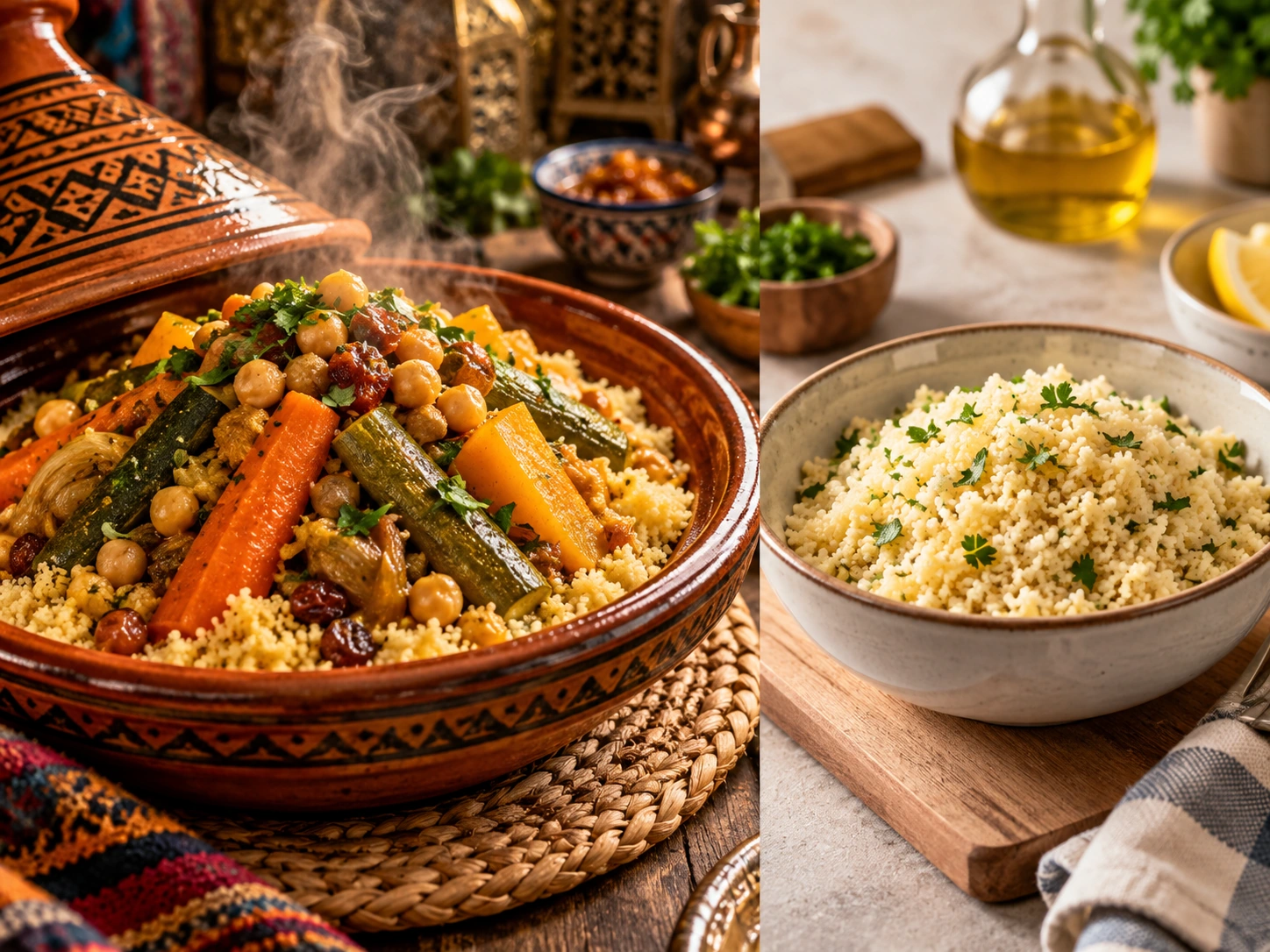
In Morocco, couscous is often associated with Friday lunches and family gatherings. Depending on the household, it might contain seven vegetables, chickpeas, lamb, chicken or a vegetarian broth. Some versions include sweet onion-and-raisin toppings. The variety is not a problem to eliminate; it is evidence of a living food culture that adapts to geography and family preference.
Our Moroccan food guide introduces the dish as part of a larger culinary landscape. The Moroccan National Tourist Office also explains its connection with communal eating and vegetable broth.
Equipment for a Traditional-Style Couscous Meal
A couscoussier is a two-part steamer: the lower pot holds simmering broth, while the upper perforated compartment holds the couscous. Steam moves upward and cooks the granules gently. The lower pot can also prepare vegetables or meat, making the process efficient despite its longer timeline. If you have a suitable steamer insert instead, ensure it is stable and safely fitted; gaps can allow too much steam to escape and lead to uneven cooking.
You will also appreciate a wide mixing bowl or shallow tray to spread and separate the granules, clean hands or a broad fork for fluffing, and a towel or mitt for managing hot equipment. A sieve is helpful for hand-rolling semolina. Choose utensils that make it easy to break apart lumps without crushing the grains.
A safety note: steaming equipment becomes extremely hot, and escaping steam can burn. Turn the heat down before lifting the steamer, keep your face away from the vapor and use appropriate protection. Traditional skill does not depend on ignoring basic kitchen safety.
How Hand-Rolled Couscous Begins
Hand-rolling starts with semolina, which is lightly moistened and moved around in a wide bowl until very small granules form. A modest dusting of finer flour may help separate particles, depending on the family method and the type of semolina. The cook rubs, rolls and sieves repeatedly to obtain reasonably even sizes. The pieces are then prepared for steaming rather than eaten as raw semolina.
Because semolina brands vary in particle size and absorption, a precise water measurement that works for one product may create paste with another. Add moisture in small increments and aim for distinct tiny grains, not dough. If large clumps form, break them apart and sieve. If the mixture remains dusty and will not roll, add a small amount of water rather than pouring in a full cup.
This is a craft worth learning from an experienced cook or a tested demonstration. Written instructions can explain the goal, but touch and visual feedback are central to the process. For a first attempt, making a small batch is much easier than trying to prepare an elaborate holiday meal on your own.

A Practical Staged-Steaming Method for Purchased Dry Couscous
For a more approachable traditional-style method, buy a dry Moroccan couscous product intended for steaming. Begin with about two cups of couscous, a few tablespoons of water for initial moistening, a little olive oil and a pinch of salt. The exact amounts and steaming stages depend on the product, so use its instructions as the baseline and treat the following as technique guidance rather than a laboratory-tested formula.
- Spread the dry couscous in a wide bowl and sprinkle with water gradually. Move the grains with your hands or a fork until evenly moistened without becoming sticky. Add a little oil to help separate them if appropriate for your method.
- Transfer loosely into the steamer basket, allowing steam to circulate. Do not press the grains into a dense block. Set the steamer over gently simmering broth or water.
- When the first steaming stage is complete according to your method, carefully remove the basket and spread the couscous in the wide bowl. Add moisture in small amounts, fluff and separate any clumps. Let the grains absorb before returning to the steamer.
- Repeat the steaming and loosening stages as required until the granules are tender, light and no longer gritty. Taste a small amount after it cools enough to eat safely. Adjust rather than relying on an exact number of minutes for every package.
- Finish with a small amount of olive oil or butter if desired, then mound the couscous on a platter and add the accompanying broth and vegetables.
This process is slower than instant couscous, but it produces a different texture and teaches the logic behind the meal. If the granules feel heavy, they may be over-wet or crowded. If they are dry in the middle, they need more moisture and time.
How to Make Instant Couscous Properly
For instant couscous, read the manufacturer’s package first. Many brands ask for a measured amount of just-boiled water or broth, a short covered rest and a final fluff with a fork. The exact ratio varies by brand and product, so a universal “one cup to one cup” rule can mislead. Using too much liquid creates paste; using too little leaves hard centers.
Season the hydration liquid lightly rather than trying to repair bland couscous afterward. For a Moroccan-inspired bowl, stir in a little olive oil and pair the couscous with separately cooked vegetables, chickpeas and a flavorful broth. Add fresh parsley or cilantro at the end. You can achieve a pleasant dinner even if you cannot reproduce the texture of couscous that has been steamed several times.
The problem comes when a quick version is marketed as a complete traditional experience without acknowledging the shortcut. Convenience is useful, but precision in naming helps readers understand what they are actually making.
Build a Moroccan-Inspired Vegetable Broth
For four servings, start with an onion, two carrots, one or two zucchini, a small turnip if available, a handful of chickpeas and tomatoes. Use enough water or low-sodium broth to simmer the vegetables, and season with ginger, turmeric, black pepper, a little cumin and salt to taste. Include parsley and cilantro if you enjoy them. Add vegetables in stages because carrots and turnips typically require longer cooking than zucchini.
To keep the meal vegetarian, use cooked chickpeas and a vegetable stock. For a meat version, cook the meat thoroughly using an appropriate recipe and food-safety method before serving. The USDA safe temperature guide provides reference temperatures for poultry, lamb and other meat; cooking until food “looks done” is not always a reliable safety check.
Ladle the hot broth around or over the couscous at the table rather than flooding the platter far in advance. Let the vegetables remain recognizable, and make additional broth available for anyone who wants a softer texture. A meal can be generous and balanced without requiring a mountain of meat.
Common Problems and How to Fix Them
Clumps: Spread couscous in a broad bowl and break lumps apart while the grains are still manageable. Excess liquid and insufficient separation are frequent causes. Dry or gritty grains: They may need additional hydration and steaming, especially with non-instant products. Mushy couscous: Too much water or prolonged soaking is difficult to reverse; serve it as a softer dish and reduce liquid next time.
Bland result: The couscous itself may need seasoning, but the broth often carries much of the flavor. Taste both components before serving. Vegetables falling apart: Introduce quick-cooking vegetables later. Unclear instructions: Check whether a recipe assumes raw hand-rolled grains, pre-steamed dried couscous or instant grains; those are not minor differences.
Do not solve every problem by adding more spices. Proper hydration, steam circulation and balanced broth matter as much as the seasoning list.
A U.S. Grocery Shopping List
Look for semolina if you want to try hand-rolling, and couscous explicitly labeled for the cooking method you intend to use. Chickpeas may appear as “garbanzo beans” on American cans. Parsley, cilantro, onions, carrots, zucchini and canned tomatoes are widely available. A specialty shop may carry a more suitable couscous grade, but you do not need exotic ingredients for a thoughtful weeknight version.
When a recipe requests preserved lemon or a particular spice mixture, consider whether you can obtain it without buying a large amount you will rarely use. Keep the fundamentals strong first: properly cooked grains, a flavorful broth and vegetables at the right tenderness. Extras can come later.
If you are planning to taste the dish in Morocco, check whether the accommodation or restaurant serves couscous on particular days. Do not assume every venue cooks a full traditional platter every day. Our Morocco travel FAQ covers broader practical travel questions, while our Morocco tours offer possible routes through major cities.

Frequently Asked Questions
Can you make couscous from regular flour?
Traditional couscous granules are generally based on semolina rather than ordinary all-purpose flour alone. Substituting plain flour changes how particles form and cook. Use the correct semolina grade for better results.
Is Moroccan couscous the same as pearl couscous?
No. Pearl couscous consists of substantially larger pasta pieces and is normally prepared differently. Follow its specific cooking directions rather than a Moroccan fine-couscous steaming recipe.
Can I steam instant couscous?
Some cooks experiment with additional steaming, but not every instant product is designed for it. Check the package and avoid assuming a multi-stage recipe is suitable for a precooked brand.
Is couscous gluten-free?
Conventional wheat semolina couscous contains gluten. A package marketed as gluten-free may use another ingredient, but it is not the same product. Check labels carefully if you must avoid gluten.
Is it necessary to use seven vegetables?
No. Seven-vegetable couscous is a recognizable preparation, but families and regions make many variations. Seasonal vegetables and a balanced broth matter more than enforcing a single count.
Why is couscous associated with Friday in Morocco?
A shared Friday meal has strong cultural meaning in many Moroccan households. That association does not mean nobody eats couscous on other days or that every family follows the same schedule.
Can I prepare couscous ahead of time?
You can prepare components separately, then cool and store them safely. Reheat the broth and grains thoroughly as appropriate, restoring moisture gradually so the couscous does not become dry or soggy.
What if I don’t own a couscoussier?
Use instant couscous for a convenient version, or research a safe, well-fitted steaming setup suitable for your cookware. The choice depends on whether you want an everyday dinner or to practice a traditional technique.
Final Thoughts
How to make couscous from scratch depends on whether you mean creating granules or cooking them. Hand-rolling is a skill; repeated steaming is a method; instant couscous is a shortcut. All can lead to enjoyable food, but they should not be described as identical. Start with the form you have, learn to control water and texture, and serve it with a broth and vegetables that give the dish its character.