


Table of Contents
Travel Daily Morocco is your practical starting point for discovering Morocco beyond a simple list of attractions. From Marrakech and Fes to Chefchaouen, the Atlantic coast, the Atlas Mountains and the Sahara, Morocco combines historic cities, traditional food, varied landscapes and memorable road trips in one destination.
This updated guide brings the most useful Morocco travel ideas together in one place, with clear links to detailed itineraries, tours, accommodation guides and practical travel resources. If you are planning your first visit, start here and then build your trip around the destinations and experiences that fit your time, season and travel style.
Why Travel Daily Morocco Is a Useful Morocco Travel Guide
Planning Morocco can become confusing quickly because the country offers far more than one standard route. Some travelers want a short Marrakech city break, others want a Sahara desert journey, and others prefer a road trip through imperial cities, mountain towns and the Atlantic coast.
A good Travel Daily Morocco guide should therefore help you answer four questions: where to go, how long to stay, how to move between destinations and which experiences are worth prioritizing.
For a complete route before choosing individual stops, see our Morocco trip itinerary. Travelers who prefer an organized journey can also compare our Morocco tours, including private, desert and multi-day options.
10 Unforgettable Experiences to Discover in Morocco
1. Explore Marrakech and the Historic Medina
Marrakech is one of the best introductions to Morocco. The Medina brings together souks, riads, traditional architecture, food stalls, gardens and historic landmarks within a compact area. Jemaa el-Fna remains the city’s most famous public space, while the surrounding lanes reveal a quieter side of Marrakech once you move away from the busiest routes.
The Moroccan National Tourist Office highlights Marrakech for its Medina, Jemaa el-Fna, souks, riads and gardens. For trip planning, see our best things to do in Marrakech and best areas to stay in Marrakech.

2. Spend a Night in the Sahara Desert
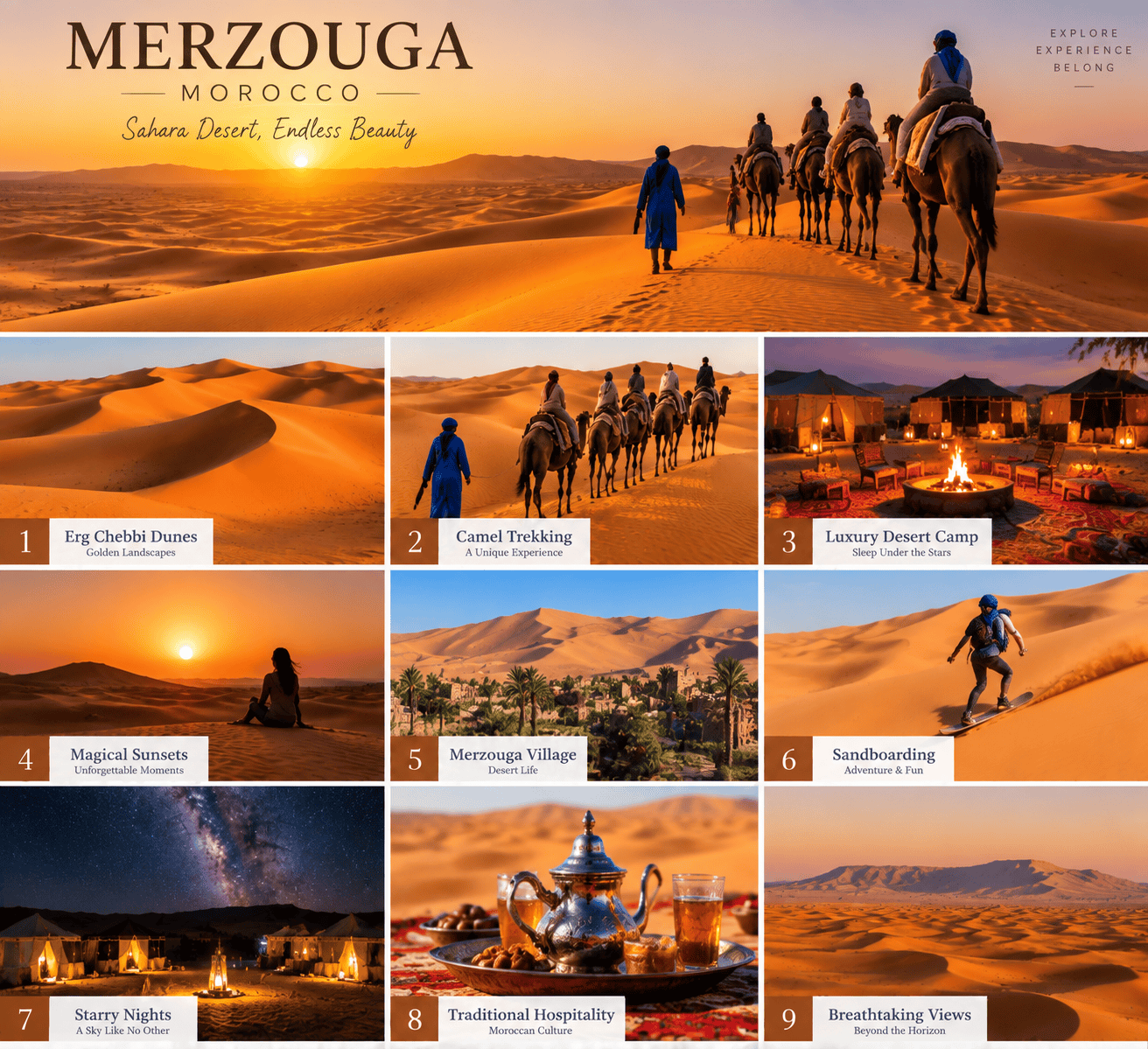
The Sahara is one of Morocco’s signature travel experiences. Around Merzouga, the Erg Chebbi dunes create the classic landscape many travelers imagine before arriving: tall sand dunes, camel trails, desert camps and wide-open skies.
A Sahara trip should not be treated as a quick excursion from Marrakech. The journey is long and works better as a multi-day route through the Atlas Mountains, valleys, kasbahs and southern towns. Compare our Morocco desert tours and Morocco desert itinerary before booking.
3. Discover the Blue Streets of Chefchaouen
Chefchaouen is one of northern Morocco’s most recognizable destinations. Its blue-painted Medina sits against the Rif Mountains and offers a slower atmosphere than Marrakech or Fes. The old town is compact enough to explore on foot, with narrow lanes, small shops, local cafés and mountain views.
The official Moroccan tourism website describes Chefchaouen as a blue mountain city known for its Medina, Kasbah and surrounding hiking opportunities. Our Chefchaouen travel guide covers the destination in more detail, while Why Is Chefchaouen Blue? explains the main stories behind its famous color.
4. Get Lost in the Historic Medina of Fes
Fes offers one of Morocco’s richest cultural experiences. The old Medina is a dense network of lanes filled with traditional workshops, markets, historic religious buildings, food stalls and architecture that rewards slow exploration.
Fes is also a useful base for trips toward Meknes, Volubilis, the Middle Atlas and the Sahara. If you are starting your route here, our Morocco itinerary from Fes gives you a practical structure for the rest of the country.

5. Slow Down on the Atlantic Coast
Morocco’s Atlantic coast offers a completely different rhythm from the imperial cities. Essaouira combines historic ramparts, a working fishing port, seafood, art galleries and a breezy coastal atmosphere. Farther south, Agadir and Taghazout are associated with beaches, surfing and relaxed stays.
The coast is especially useful if you want to balance busy city sightseeing with slower days. Morocco’s official tourism board groups destinations such as Essaouira, Casablanca, Agadir and Taghazout among the country’s major coastal experiences.
6. Taste Traditional Moroccan Food
Food is one of the easiest ways to understand Morocco’s regional diversity. Tagine and couscous are the best-known dishes internationally, but travelers should also look for harira, pastilla, grilled meats, local breads, Moroccan salads, pastries and regional specialties.
Mint tea is equally important to the social experience. It appears in riads, homes, cafés and shops, and often becomes part of the rhythm of a trip rather than just another drink to photograph before it gets cold.
7. Stay in a Traditional Moroccan Riad
A riad is a traditional Moroccan house organized around an interior courtyard or garden. Many historic riads have been restored as guesthouses and boutique hotels, particularly in Marrakech and Fes.
For travelers who want atmosphere and traditional architecture, a riad can be more memorable than a conventional hotel. Our guide to what a riad is in Morocco explains the design, accommodation style and what to check before booking.
8. Cross the Atlas Mountains
The Atlas Mountains shape Morocco’s geography and many of its most scenic routes. Travelers heading from Marrakech toward Ouarzazate, Ait Ben Haddou and the Sahara cross mountain landscapes that can feel completely different from the cities only a few hours away.
If you enjoy independent travel, the mountains are one reason a car can be useful. Our Rent a Car Morocco guide explains city pickup, airport rental and road-trip planning.
9. Explore Ait Ben Haddou and Southern Kasbah Routes
Ait Ben Haddou is one of Morocco’s most famous earthen settlements and an important stop on routes between Marrakech and the southeast. The wider area around Ouarzazate, valleys and kasbahs makes the journey toward the desert part of the experience rather than just transport between two points.
Travelers planning to drive should use our Morocco road trip itinerary to avoid trying to fit unrealistic distances into a single day.
10. Combine Morocco’s Imperial Cities
Rabat, Fes, Meknes and Marrakech are Morocco’s imperial cities. Each has served as a capital during different periods and each offers a different combination of monuments, medinas, museums and local life.
A multi-city itinerary gives a much better sense of Morocco than staying in one tourist center for an entire trip. If your time is limited, a 7-day Morocco itinerary works as a starting point. With more time, compare our 10-day Morocco itinerary or 2 weeks in Morocco itinerary.
How Many Days Do You Need in Morocco?
The ideal trip length depends on how much of the country you want to see.
- 5 days: focus on one region, such as Marrakech plus nearby excursions, or Fes and northern Morocco.
- 7 days: enough for a focused multi-city route, but still relatively fast.
- 10 days: a strong balance for cities, desert and cultural stops.
- 2 weeks: better for a slower route that includes the north, imperial cities, Sahara and coast.
Trying to combine Tangier, Chefchaouen, Fes, Marrakech, the Sahara and Agadir in four days is technically a travel plan, in the same sense that sprinting through a museum with your eyes closed is technically a museum visit.
Best Time to Visit Morocco
Morocco can be visited throughout the year, but the best season depends on your route. Spring and autumn are popular because temperatures are generally comfortable for city sightseeing and outdoor travel. Summer suits the Atlantic coast better than the interior or desert, where heat can be intense. Winter can work well for cities and desert travel, while mountain areas can be significantly colder.
For a month-by-month decision, read our best month to go to Morocco guide.
How to Get Around Morocco
Morocco offers several useful transport options, and the best choice changes by route.
Train
Rail is convenient between several major cities, particularly Tangier, Rabat, Casablanca and Fes. Al Boraq high-speed services are especially useful on the Tangier-Casablanca corridor. See our Al Boraq first class vs second class comparison before choosing a ticket.
Rental Car
A rental car is useful when you want flexibility for coastal drives, mountain routes and smaller towns. It is less necessary if your trip is limited to well-connected city centers.
Private Tours
Private tours are useful for travelers who want to combine long-distance transport with local guiding and pre-arranged accommodation. Compare our private Morocco tours.
Where to Stay in Morocco
Accommodation ranges from traditional riads and guesthouses to large resorts and international hotels. The best choice depends on destination and travel style.
For old cities such as Marrakech and Fes, staying in or near the Medina gives you atmosphere and easy access to historic sights. In Casablanca, Rabat and Agadir, modern districts can be more convenient for road access, business travel or beach stays.
Use our Where to Stay in Morocco hub to compare cities, neighborhoods, hotels and riads.
Morocco Travel Costs and Budget Planning
Morocco works for a wide range of budgets. Local cafés, public transport and simple guesthouses can keep costs moderate, while luxury riads, private drivers, premium desert camps and high-end tours can raise the daily budget quickly.
When comparing prices, account for accommodation, transport between cities, activities, meals and tips rather than looking only at hotel rates. Our Morocco tour cost guide explains typical tour pricing, while tipping in Morocco covers common situations.
Money and Currency in Morocco
The Moroccan dirham is the local currency. Cash remains useful for small purchases, markets, taxis and some local businesses, while cards are common in many hotels and larger establishments.
If you are arriving with euros, read Do They Take Euros in Morocco? before deciding how much cash to exchange.
Language in Morocco
Arabic and Amazigh are Morocco’s official languages. Moroccan Arabic, commonly called Darija, is widely spoken in daily life. French is also common in tourism, business and many urban settings, while English is increasingly used in major visitor destinations.
Our What Language Is Spoken in Morocco? guide includes a clearer explanation and useful phrases for visitors.
Is Morocco Safe for Travelers?
Millions of travelers visit Morocco for city breaks, tours, beach holidays and road trips. As in any destination, visitors should use normal precautions: protect valuables, use reputable transport, avoid accepting unclear services from unofficial guides and research local customs before arrival.
For a fuller breakdown, see our Is Morocco Safe to Visit? guide.
How to Build a Balanced Morocco Itinerary
The best itineraries do not simply include the maximum number of famous places. They balance travel time with actual time in each destination.
- Choose one or two anchor cities. Marrakech, Fes, Casablanca or Tangier can each work as a starting point.
- Add one major landscape experience. Choose the Sahara, Atlantic coast or mountains rather than trying to force all three into a short trip.
- Check real driving or train times. Morocco is larger in practice than it can look on a route map.
- Leave room for slow experiences. A medina, riad breakfast or coastal afternoon often becomes more memorable than another rushed attraction.
If you are arriving through a specific city, we have dedicated itineraries from Marrakech, Casablanca, Fes and Tangier.
Frequently Asked Questions About Travel Daily Morocco
What is the best time to visit Morocco?
Spring and autumn are popular for comfortable temperatures across many regions. Summer is better suited to the Atlantic coast, while winter can be excellent for cities and the desert, depending on your preferences.
How many days are enough for a Morocco trip?
Seven days is a useful minimum for a focused multi-city trip. Ten days provides a better balance, while two weeks allows a slower journey through several regions.
Is Morocco expensive for tourists?
Morocco can suit both budget and luxury travelers. Costs vary significantly according to accommodation, transport style, private tours and the number of long-distance transfers.
Do I need a car in Morocco?
No for a city-focused trip using trains and transfers. A car becomes more useful for flexible coastal, mountain and rural routes.
Which city should I visit first in Morocco?
Marrakech is the most common first stop for leisure travelers, but Fes is excellent for history, Tangier for northern routes and Casablanca for international flight connections and Atlantic itineraries.
Is the Sahara worth adding to a first Morocco trip?
Yes if you have enough time. Plan at least a multi-day route rather than attempting a rushed out-and-back journey.
Official Morocco Travel Resources
For official destination information, practical travel guidance and current tourism resources, use the Moroccan National Tourist Office. Its official site includes destination pages for Marrakech, Chefchaouen, Fes, Casablanca, coastal regions and the desert, plus information about accommodation, getting around, food and travel planning.
You can also consult the official Morocco must-know travel guide for background on medinas, imperial cities and other key travel concepts.
Final Travel Daily Morocco Planning Advice
Travel Daily Morocco is most useful when it helps you move from inspiration to a realistic plan. Start with the regions you genuinely want to experience, give each destination enough time, and use the detailed guides linked above to build the route.
For most first-time travelers, a combination of one imperial city, one cultural destination, one major landscape experience and a few slower days creates a stronger trip than chasing every famous place in one journey. From Marrakech and Fes to Chefchaouen, the Sahara and Atlantic coast, Morocco rewards travelers who leave enough time to actually experience where they are.
