


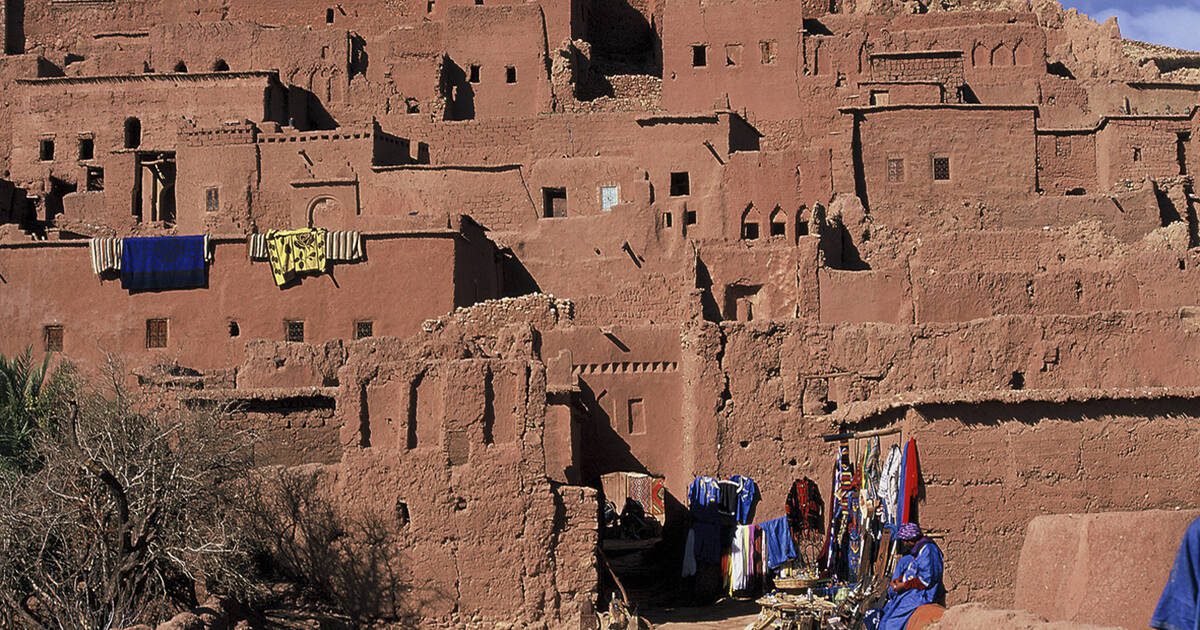
What is a kasbah? In Morocco, a kasbah is generally a fortified residence, stronghold or protected complex associated with defense, authority and traditional earthen architecture. The word appears constantly on Morocco itineraries, yet it is often used so loosely that travelers end up calling every mud-brick building a kasbah.
Understanding the term makes journeys through Ouarzazate, the High Atlas, the Dades Valley and the Draa Valley much more interesting. You begin to notice how architecture responded to climate, security, trade routes and family power. You also learn why Ait Ben Haddou, despite being frequently marketed as a kasbah, is more accurately described as a ksar.
Quick definition: A kasbah is a fortified residence or stronghold. A ksar is a fortified village. A riad is an inward-facing urban home built around a courtyard or garden.
Table of Contents
- Kasbah meaning
- History of kasbahs
- How kasbahs were built
- Kasbah vs ksar
- Kasbah vs riad
- Famous kasbahs in Morocco
- Ait Ben Haddou
- Ouarzazate and Taourirt
- Telouet Kasbah
- How to include kasbahs in a trip
- Preservation and responsible visits
- FAQ
Kasbah Meaning: What Does the Word Actually Mean?
The word “kasbah” has been used across North Africa in several related ways. Depending on the city and historical context, it can describe a fortified citadel, a defensive quarter, a stronghold or a fortified residence. In Morocco’s south, travelers often encounter the term in connection with multi-story earthen buildings decorated with geometric motifs.
That means there is no single floor plan that makes a structure a kasbah. Function is important. Historically, walls, towers and controlled entrances helped protect residents, food stores, animals and valuables. Some kasbahs were associated with local leaders or influential families, while others formed part of larger fortified landscapes.
Why Were Kasbahs Built?
Morocco’s trans-Saharan and regional trade routes moved people, salt, gold, livestock, textiles and other goods across difficult landscapes. Settlements along those routes needed places that could offer protection and store resources. Political rivalries, tribal relationships and local authority also shaped fortified architecture.
In mountain valleys and oasis zones, a kasbah could be both home and statement. Thick earthen walls moderated temperature, defensive towers provided visibility, and compact design reduced exposure. The architecture was not decorative fantasy built for tourists. It was a practical response to environment and social organization.
Many surviving structures were altered repeatedly over generations. Their present appearance therefore reflects layers of repair, abandonment, restoration and tourism rather than one frozen historical moment.
How Traditional Moroccan Kasbahs Were Built
Southern Moroccan architecture commonly relies on local earth, stone, straw and timber. Rammed-earth techniques create thick walls with high thermal mass, helping interiors remain cooler during hot days and retain warmth after sunset. Wooden beams support floors and roofs, while decorative brick or earthen patterns often appear around upper sections and towers.
This construction is environmentally logical but maintenance-intensive. Heavy rain can erode exposed walls, and abandoned buildings deteriorate quickly when roofs fail. Restoration therefore requires more than painting a picturesque façade. Traditional materials and drainage methods matter if the structure is to survive without losing its character.
The most dramatic kasbahs often have corner towers, narrow openings and ornamented upper walls. Interior courtyards, storage rooms and living spaces reveal that defense and domestic life were combined rather than separated.
Kasbah vs Ksar: What Is the Difference?
This is the distinction most Morocco travel content gets wrong. A kasbah is usually a fortified residence or stronghold. A ksar is a fortified village that contains multiple households and shared elements such as lanes, storage spaces, a mosque or communal areas.
The UNESCO-listed Ksar of Ait-Ben-Haddou is the perfect example. From a distance it looks like one monumental fortress, but it is actually a compact fortified settlement built from earthen materials.
Tour companies and visitors sometimes use the words interchangeably because “kasbah” is more familiar in English. Knowing the difference will not ruin your holiday. It will, however, save you from confidently correcting a local guide with the wrong term, which is always a small victory.
Kasbah vs Riad
A riad belongs to a different architectural tradition. Traditional riads are urban houses organized inward around a central courtyard or garden. Their exterior can appear plain because privacy is directed away from the street, while the interior may feature tilework, carved plaster, fountains and greenery.
A kasbah, by contrast, communicates protection and control through fortified walls, towers and strategic positioning. Riads are strongly associated with medinas such as Marrakech and Fes; kasbahs are especially visible in southern valleys, oasis landscapes and historic routes.
Famous Kasbahs and Fortified Sites in Morocco
Travelers commonly encounter Taourirt Kasbah in Ouarzazate, Telouet Kasbah in the High Atlas, Amridil in the Skoura Oasis and numerous structures through the Dades and Draa valleys. Each has a different condition and history, so avoid expecting every site to offer the same visitor experience.
Some are restored monuments with managed access. Others remain partly ruined, privately occupied or integrated into living villages. Ask before entering residential areas and never assume an open doorway is a public museum entrance.
Ait Ben Haddou: Kasbah or Ksar?
Ait Ben Haddou is technically a ksar and is one of the strongest places to understand the wider fortified architecture of southern Morocco. The settlement rises above the Ounila Valley on the historic route between Marrakech and Ouarzazate. Its clustered earthen buildings create the famous silhouette seen in countless photographs and film productions.
Our complete Ait Ben Haddou Morocco guide covers how to get there, how long to stay and how to combine the site with a desert itinerary. If traveling from Marrakech, many Marrakech desert tours stop here on the first day.
Taourirt Kasbah and Ouarzazate
Ouarzazate developed as an important regional center and gateway between the High Atlas and the desert-facing valleys. Taourirt Kasbah is one of its major historic landmarks. Its maze of rooms, passages and decorated spaces shows how a large fortified residence functioned beyond its exterior towers.
Ouarzazate also works as a practical overnight stop for travelers who want to slow down rather than race from Marrakech to Merzouga. The city provides hotels, restaurants, film studios and road connections toward Skoura, Dades and the Draa Valley.
Telouet Kasbah
Telouet sits on a historic route through the High Atlas and is associated with the Glaoui family, which held significant regional power before Moroccan independence. The exterior can appear weathered, but surviving interior decoration demonstrates the contrast between austere defensive architecture and elaborate elite spaces.
Road conditions and access arrangements can change, so check locally before planning a detour. Telouet combines well with the Ounila Valley and Ait Ben Haddou for travelers interested in architecture rather than simply collecting desert photos.
How to Build Kasbahs into a Morocco Itinerary
A classic route begins in Marrakech, crosses the High Atlas, visits Telouet or Ait Ben Haddou, continues through Ouarzazate and Skoura, then enters the Dades and Todra valleys before reaching Merzouga. This route turns a desert trip into a journey through architecture and landscape rather than a long drive with a camel at the end.
For planning, compare our Marrakech to Sahara Desert, Dades Valley and Todra Gorge guides.
Respecting Historic Earthen Architecture
Earthen monuments are fragile. Do not climb walls, scratch names into surfaces or enter unstable rooms for a better photograph. Support official entry systems, local guides and restoration initiatives where available. In inhabited ksour, remember that people live behind the photogenic walls.
Photography should also respect residents. Ask before photographing people closely, especially children. Buying a local meal, hiring a legitimate guide or purchasing crafts directly can contribute more to a community than racing through the village for ten minutes of content.
Frequently Asked Questions
What is a kasbah?
A kasbah is a fortified residence, stronghold or protected quarter. In Morocco, the word is commonly used for fortified earthen buildings associated with powerful families, local rulers or strategic settlements.
What does kasbah mean in Morocco?
In Moroccan travel usage, kasbah often refers to a fortified building or complex built with rammed earth and local materials. The exact architectural meaning varies by region and historical period.
What is the difference between a kasbah and a ksar?
A kasbah is usually a fortified residence or stronghold, while a ksar is a fortified village containing multiple homes and community structures. Ait Ben Haddou is technically a ksar, although many travelers casually call it a kasbah.
Is Ait Ben Haddou a kasbah?
Ait Ben Haddou is a ksar, a fortified village. The phrase ‘Kasbah Ait Ben Haddou’ is widely used in tourism, but the UNESCO World Heritage listing identifies it as Ksar of Ait-Ben-Haddou.
What is the difference between a riad and a kasbah?
A riad is traditionally an inward-facing urban house organized around a courtyard or garden. A kasbah is associated with fortification, defense and political or residential authority.
Where can I see famous kasbahs in Morocco?
Popular examples include Taourirt Kasbah in Ouarzazate, Telouet Kasbah in the High Atlas region and many fortified structures along the Draa and Dades valleys.
Are Moroccan kasbahs made from mud?
Many southern Moroccan kasbahs use earthen construction such as rammed earth and adobe-like techniques mixed with straw, timber and stone. These materials require maintenance because rain and erosion can damage them.
Can you stay in a kasbah?
Some restored kasbah-style buildings now operate as guesthouses or hotels. Others are historic monuments, family properties or ruins and are not accommodation.
Additional Practical Planning Notes
Kasbahs, Climate and Landscape
The connection between architecture and landscape is easiest to see in southern Morocco. Builders used earth from the surrounding environment, producing walls whose colors blend into valleys and plateaus. Thick walls also help moderate temperature, an elegant response to large day-night swings.
How Long to Spend at a Kasbah
A roadside photo stop may take twenty minutes, but a major site such as Ait Ben Haddou or Taourirt rewards at least an hour. Add time if you want a local guide, interior visit or walk to a viewpoint. Avoid stacking several sites so tightly that architecture becomes interchangeable.
Questions to Ask a Local Guide
Ask who lived in the building, how water was stored, which parts are original, how roofs were maintained and how trade routes shaped the settlement. Specific questions produce better explanations than asking only when the kasbah was ‘built,’ because many were modified over generations.
How to Use This Guide in Your Morocco Itinerary
Do not treat a single article as a substitute for checking opening hours, weather, road conditions or current regulations close to the date of travel. Morocco changes by region and season. Build the topic into the wider route, compare distances honestly and leave margin for meals, prayer times, traffic and spontaneous stops. Travelers who schedule every hour usually discover that the country has not signed their spreadsheet.
Local Guides and Independent Travel
Independent travel works well in many Moroccan cities and on major roads, while a local guide adds value when interpretation matters. Choose licensed or well-reviewed professionals, agree on price and scope in advance, and clarify whether shopping stops are part of the tour. A good guide should improve your understanding rather than simply accelerate your movement between souvenir shops.
Photography and Respect
Ask before taking close photographs of people, especially children, craftspeople at work and residents in small communities. Religious spaces may restrict photography or entry. A landscape may be public, but a doorway, courtyard or family moment is not automatically content. Respect makes better travel and usually better photographs too.
Budgeting and Cash
Keep small cash available for cafés, tips, taxis and minor purchases, but avoid carrying your entire travel budget. ATMs are common in cities, less dependable in remote areas and sometimes subject to withdrawal fees. Carry a backup card stored separately and tell your bank about travel if necessary.
Final Planning Advice
The best Morocco trips balance preparation with flexibility. Reserve important accommodation and long transfers, understand the cultural context, then leave enough room to change pace. The places travelers remember most are often not the ones that occupied the largest box in the itinerary.
